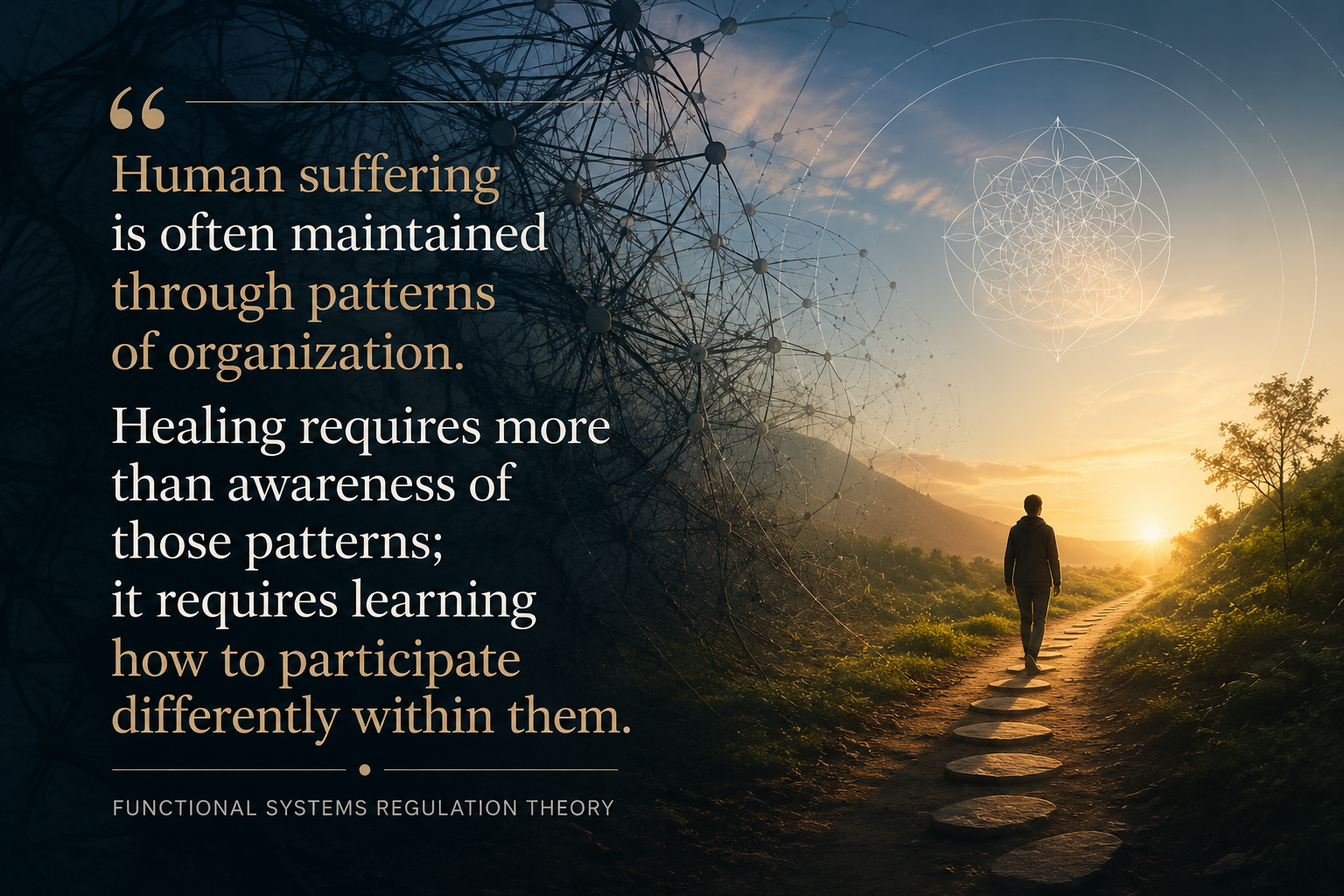
What Trauma, Psychedelic Experiences, and Psychotherapy Reveal About Lasting Change
Contemporary healing culture places tremendous value on moments of revelation. Whether encountered through psychotherapy, spiritual practice, meditation, self-reflection, or psychedelic experiences, many people find themselves searching for an experience that will finally allow everything to make sense. The hope is understandable. When suffering has persisted for years, insight can feel like the missing piece. If the pattern can be understood clearly enough, perhaps it can finally be changed.
Experiences of this nature can be profoundly meaningful. Individuals often emerge with a deeper understanding of their histories, relationships, behaviors, and emotional lives. They may recognize how childhood experiences continue influencing adult relationships, understand the origins of longstanding fears, or develop greater compassion for aspects of themselves that were previously met with judgment.
Yet an observation repeatedly emerges across psychotherapy, trauma treatment, addiction recovery, and psychedelic work. Human beings often gain significant insight into their lives while continuing to struggle with many of the same patterns that originally brought them to seek help.
This raises an important question. If awareness creates transformation, why do so many people continue repeating patterns they fully understand?
From an FSRT perspective, the answer may lie in the difference between revelation and reorganization.
Revelation involves a shift in awareness. Reorganization involves a shift in the systems that shape how a person lives, relates, and participates in the world.
While these processes often influence one another, they are not the same thing. Understanding a pattern does not necessarily alter the conditions that sustain it. An individual may gain extraordinary clarity regarding their suffering while remaining embedded within the biological, psychological, relational, environmental, and cultural systems through which that suffering continues to be organized.
This distinction becomes particularly relevant when examining trauma. Trauma is often discussed as something that happened in the past. While past events certainly matter, the enduring impact of trauma is not found solely in memory. Trauma continues to express itself through patterns of adaptation that influence perception, emotion, behavior, relationships, and physiology in the present.
Viewed this way, trauma is not simply a story waiting to be understood. It is a living pattern of organization.
FSRT refers to this tendency as Homeostatic Patterning: the tendency of living systems to return to familiar forms of organization, even when those forms produce suffering. Familiarity is often mistaken for safety, causing individuals, relationships, families, and communities to repeatedly recreate conditions they consciously wish to escape.
Trauma as Organization Rather Than Pathology
Much of modern mental health discourse continues to frame trauma through the language of pathology. Symptoms are identified, diagnoses are assigned, and treatment often focuses on reducing or eliminating forms of distress. While these approaches can be valuable, they can also obscure an important reality: many trauma-related patterns emerge not because something is inherently wrong with the individual, but because the individual adapted to conditions that required those patterns to develop.
Human beings are remarkably adaptive organisms. Throughout life, biological, psychological, relational, and environmental systems continuously respond to changing conditions. When those conditions are relatively safe and predictable, systems often organize around exploration, connection, creativity, learning, and growth. When conditions become threatening, chaotic, neglectful, or chronically overwhelming, different forms of organization emerge.
From this perspective, many of the experiences commonly labeled as symptoms can be understood as adaptations. Hypervigilance may develop as an attempt to anticipate danger before it arrives. Emotional numbing may function as protection against experiences that feel intolerable. Avoidance may reduce exposure to situations associated with overwhelm, while perfectionism, people-pleasing, chronic self-reliance, and other familiar patterns can emerge as strategies for creating predictability within uncertain environments.
The challenge is that adaptive responses often persist long after the conditions that originally required them have changed. What once promoted survival may later interfere with intimacy. What once created safety may eventually contribute to isolation. What once reduced distress may ultimately limit participation in life.
Within FSRT, this tendency is understood through the concept of Homeostatic Patterning. Living systems naturally gravitate toward familiar forms of organization, even when those forms produce suffering. Familiarity is frequently experienced as safety, causing individuals to repeatedly recreate patterns they consciously wish to escape. Over time, these patterns can become embedded not only within the nervous system, but within relationships, families, communities, institutions, and broader cultural environments.
A person raised in an unpredictable environment may become hypervigilant. That hypervigilance can influence the relationships they form, the environments they seek out, the ways they communicate, the boundaries they establish, and the assumptions they make about other people. Those relational patterns then shape new experiences, which reinforce the original adaptation. What began as a response to past conditions gradually becomes part of a larger self-sustaining system.
This process extends beyond individuals. Families often transmit relational patterns across generations. Communities can normalize forms of disconnection, distrust, or chronic stress. Institutions may unintentionally reinforce the very conditions that contribute to dysregulation. Cultural narratives can shape what forms of adaptation are rewarded, tolerated, or ignored. As these systems interact, patterns become increasingly stable and increasingly difficult to recognize.
From an FSRT perspective, trauma is therefore less accurately understood as damage and more accurately understood as organization. The question is not simply what happened to an individual, but how multiple interconnected systems adapted to what happened and how those adaptations continue shaping present experience.
This shift in perspective expands the focus beyond pathology and symptom reduction. It invites consideration of the broader patterns through which suffering is maintained and, ultimately, the conditions that may be required for meaningful reorganization to occur.
Why Awareness Often Fails to Produce Change
Once trauma is understood as a pattern of organization rather than merely a collection of symptoms, it becomes easier to understand why awareness alone often fails to produce lasting change.
Insight can reveal a pattern. It does not automatically reorganize the systems that sustain it.
An individual may recognize that their fear of rejection developed within a critical family environment. They may understand why vulnerability feels threatening. They may accurately identify how past experiences continue influencing present relationships. Yet despite this awareness, they may continue withdrawing when intimacy increases, anticipating criticism where none exists, or seeking reassurance in ways that ultimately recreate the very dynamics they wish to escape.
This does not occur because the insight is insufficient. Nor does it necessarily reflect resistance, denial, or a lack of motivation. Rather, it reflects the reality that human behavior emerges from interconnected systems operating simultaneously across multiple levels.
A person's beliefs may change while their relationships remain unchanged. Their understanding may evolve while their environment continues reinforcing older patterns. Their intentions may shift while their nervous system remains organized around familiar forms of protection.
Living systems tend to preserve established patterns because those patterns represent accumulated solutions to previous challenges.maintaining it. Even when these solutions no longer serve the individual, they often continue operating until alternative forms of organization become sufficiently developed and supported.
This tendency reflects the broader process of Homeostatic Patterning. Systems generally organize around familiarity before they organize around well-being. As a result, individuals may consciously desire change while unconsciously participating in patterns that recreate familiar forms of distress. Awareness can reveal the pattern, but awareness alone does not necessarily alter the forces
For this reason, awareness is often best understood as a beginning rather than an endpoint. Insight may illuminate the architecture of a pattern, but illumination alone does not rebuild the structure. Lasting change typically requires shifts across the broader network of biological, psychological, relational, environmental, and cultural influences that participate in sustaining that pattern.
What Psychedelic Experiences Reveal About Human Systems
Psychedelic experiences provide a particularly interesting lens through which to examine the relationship between awareness and reorganization because they frequently generate forms of insight that feel immediate, undeniable, and deeply significant.
Individuals often report encountering memories with unusual clarity, recognizing longstanding behavioral patterns, experiencing profound emotional release, or developing entirely new perspectives on themselves and their lives. Many describe feeling connected to something larger than themselves, while others report a renewed sense of meaning, purpose, compassion, or possibility.
Experiences such as these can be extraordinarily valuable. They may interrupt rigid patterns of thinking, increase psychological flexibility, and allow individuals to perceive aspects of themselves that previously remained inaccessible. In many cases, they create opportunities for healing that might otherwise have remained unavailable.
At the same time, psychedelic experiences reveal an important truth about human systems. Awareness and transformation are not synonymous.
An individual may leave a ceremony, retreat, or therapeutic session with a dramatically altered understanding of their life while finding that many of the same challenges reappear in the weeks and months that follow. The insight remains. The memory remains. The experience remains meaningful. Yet familiar patterns gradually reemerge.
This observation does not diminish the value of psychedelic work. Rather, it highlights something important about the nature of change itself.
Psychedelic experiences often create temporary shifts in how systems are organized. Previously rigid patterns may become more flexible. New possibilities may become visible. Alternative ways of relating to oneself and others may suddenly feel accessible. For a period of time, the system may operate differently than it ordinarily does.
What follows the experience often proves more influential than the experience itself.
If the broader conditions shaping daily life remain unchanged, older patterns frequently regain influence. Relationships, environments, routines, responsibilities, social structures, and longstanding forms of regulation continue exerting their effects. The system gradually reorganizes around what is familiar.
In this sense, psychedelic experiences often reveal possibilities rather than establish them. They may show individuals what healing could look like, what different forms of participation might feel like, or what becomes available when familiar constraints loosen. Whether those possibilities become integrated into everyday life depends largely upon what occurs after the experience itself.
The experience may reveal new possibilities, but whether those possibilities become part of everyday life depends upon the extent to which broader systems reorganize around them.
The Difference Between Revelation and Reorganization
The distinction between revelation and reorganization may represent one of the most important concepts in understanding lasting change.
Revelation occurs when something previously unseen becomes visible. An individual gains insight into a pattern, recognizes a connection, experiences a shift in perspective, or encounters a deeper understanding of themselves and their circumstances. Revelation changes what is known.
Reorganization involves something different. It occurs when the systems shaping daily life begin functioning in new ways. Relationships evolve. Behaviors change. Patterns of regulation shift. Different forms of participation become possible. Reorganization changes how life is lived.
While revelation can contribute to reorganization, the two should not be confused. One can occur without the other.
An individual may clearly recognize the origins of their suffering while remaining organized around the same relational patterns, environmental conditions, and regulatory strategies that contributed to that suffering in the first place. Conversely, meaningful reorganization sometimes begins before a person fully understands why it is occurring. New experiences, relationships, responsibilities, and environments can gradually reshape a system even in the absence of profound insight.
This distinction helps explain why moments that feel transformative do not always result in lasting change. The revelation may have been genuine. The insight may have been accurate. Yet if the broader systems surrounding the individual remain unchanged, familiar patterns often reassert themselves over time.
Lasting change typically requires more than a shift in awareness. It requires sufficient changes within the conditions that support daily living such that a different way of being becomes sustainable. From an FSRT perspective, healing is therefore less about accumulating insights and more about supporting processes of reorganization across interconnected systems.
The Delusion of Comfort
One of the challenges that frequently emerges within healing work is the tendency to seek relief from distress while preserving the conditions that generate it.
Most individuals naturally want to feel better. They seek freedom from anxiety, depression, addiction, trauma-related symptoms, emotional pain, or relational suffering. There is nothing inherently problematic about this desire. The difficulty arises when comfort becomes confused with healing.
Relief can occur without transformation.
A person may temporarily escape distress through distraction, avoidance, compulsive behaviors, unhealthy relationships, substances, or even repeated pursuit of peak experiences. While these strategies may reduce discomfort in the short term, they often leave the underlying systems generating that discomfort unchanged.
The same dynamic can emerge within healing practices themselves. Therapy, spiritual practice, self-development work, and psychedelic experiences can all become subtle attempts to feel different without living differently. Individuals may continue seeking new insights, new experiences, or new breakthroughs while avoiding the difficult process of altering the relationships, responsibilities, boundaries, environments, and habits that sustain familiar forms of suffering.
This pattern reflects what FSRT describes as the Delusion of Comfort. The belief that relief from distress and genuine healing are equivalent.
In reality, healing often requires movement toward forms of discomfort that support growth. Honest conversations may feel uncomfortable. Establishing boundaries may feel uncomfortable. Entering new relationships may feel uncomfortable. Leaving familiar environments may feel uncomfortable. Assuming greater responsibility may feel uncomfortable.
Yet many of these experiences contribute to reorganization in ways that temporary relief cannot.
The question therefore shifts from "What helps me feel better right now?" to "What supports the development of a healthier and more coherent way of participating in life over time?"
The answers to those questions are not always the same.
Healing as Participation
If suffering emerges within interconnected systems, healing must also involve participation within those systems.
This idea represents a fundamental shift away from viewing healing as something that occurs exclusively within the mind of an individual. Human beings do not exist in isolation. We are continuously shaped by relationships, communities, environments, cultural narratives, responsibilities, opportunities, limitations, and countless other influences operating simultaneously.
For this reason, healing cannot be reduced to a single insight, intervention, ceremony, medication, or therapeutic technique. While each may contribute to the process, lasting change typically emerges through ongoing participation in experiences that support different forms of organization.
Participation may involve learning to engage emotions that were previously avoided. It may involve developing relationships characterized by greater honesty and reciprocity. It may require changing environments that continually reinforce dysregulation. It may involve reconnecting with community, purpose, creativity, spirituality, contribution, or meaningful forms of responsibility.
These changes often occur gradually. They may not produce the dramatic intensity associated with breakthrough experiences. Yet over time they contribute to something that revelation alone cannot accomplish. They alter the conditions through which life is continuously organized.
From this perspective, integration is not simply the process of reflecting upon an experience. Integration involves translating insight into participation. The question is no longer what was learned, but how that learning becomes expressed within daily life.
Healing becomes less about preserving an experience and more about allowing the experience to influence the way one lives.
Why Therapy Still Matters
Understanding healing as reorganization helps clarify the enduring value of psychotherapy, particularly within an era of increasing interest in psychedelic-assisted therapies.
Therapy is sometimes viewed primarily as a vehicle for insight. While insight can certainly emerge within therapeutic work, its deeper contribution often lies elsewhere.
At its best, therapy functions as a relational environment capable of supporting reorganization. Within the therapeutic relationship, individuals are given opportunities to experience trust differently, express vulnerability differently, relate to emotions differently, and develop alternative responses to longstanding patterns.
These experiences may appear subtle when compared to the intensity of psychedelic experiences. Yet they often contribute to precisely the forms of change that support long-term healing. New ways of relating are practiced repeatedly. Previously avoided emotions become more tolerable. Greater flexibility develops. Alternative narratives emerge. Different possibilities become available.
Therapy also provides something that many transformative experiences cannot offer on their own: continuity.
While moments of revelation are often temporary, therapeutic relationships can provide ongoing support as individuals navigate the challenges associated with reorganizing their lives. In this sense, therapy does not compete with transformative experiences. Rather, it helps create conditions through which those experiences can become integrated into enduring patterns of living.
Beyond Revelation
Revelation has value. Insight has value. Awareness has value.
Each can illuminate aspects of human experience that might otherwise remain hidden. Each can provide meaning, perspective, and direction. Yet lasting healing rarely occurs because a single realization finally explains everything.
More often, healing emerges through a gradual process in which interconnected systems begin organizing themselves differently. Relationships evolve. Environments change. New capacities develop. Different forms of participation become possible. What once required enormous effort gradually becomes more natural.
This process is rarely linear. It does not unfold according to a predictable sequence of insights or breakthroughs. Rather, it reflects the ongoing relationship between individuals and the systems within which they live.
From an FSRT perspective, the most important question may therefore not be what was revealed.
The more important question may be what has been reorganized.
Awareness can reveal possibilities that were previously hidden from view. Reorganization determines whether those possibilities become part of how a person lives.
Many people spend years searching for the experience that will finally change their lives. Sometimes that experience arrives through therapy, psychedelic work, spiritual practice, relationship, loss, illness, parenthood, or unexpected moments of clarity. Such experiences can reveal possibilities that were previously hidden from view. Yet the future is rarely determined by what was revealed in a single moment. More often, it is shaped by what is repeatedly practiced, supported, embodied, and lived in the months and years that follow.
Healing emerges not simply through what we come to understand, but through the ways we gradually learn to participate differently in the living systems that shape our lives.
Continue Exploring
The concepts discussed in this article continue to evolve through clinical practice, psychedelic-assisted psychotherapy, and systems-oriented approaches to healing and integration.
✦ Psycholytic Services (Vero Beach, Florida) – Individual psychotherapy, psychedelic integration, ketamine-assisted psychotherapy, and clinical consultation informed by Functional Systems Regulation Theory.
✦ Ketamine Healing Group (Boynton Beach, Florida) – Ketamine-assisted psychotherapy, Stellate Ganglion Block (SGB), and innovative approaches to trauma treatment, nervous system regulation, depression, anxiety, and PTSD.
✦ Plantas Sagradas (Tijuana, Mexico) – Retreat experiences focused on healing, self-exploration, integration, and experiential understanding of consciousness through traditional plant medicine practices.
Add comment
Comments