Origins
From Origin to Stewardship

Functional Systems Regulation Theory™ (FSRT) emerged from sustained clinical work with people whose distress could not be fully understood through models that located dysfunction primarily within the individual.
Across psychotherapy, addiction treatment, ketamine-assisted psychotherapy, psychedelic preparation and integration, and other behavioral health settings, a consistent pattern became increasingly visible: people were often responding intelligently to conditions that remained unrecognized or unchanged.
Symptoms that appeared irrational in isolation frequently became understandable when viewed within the larger systems in which they developed. Anxiety could function as vigilance. Withdrawal could preserve safety. Compulsive behavior could temporarily regulate unbearable internal pressure. Emotional numbing could protect a person from experiences they did not yet have the capacity or support to hold.
From this perspective, distress is not automatically evidence of personal failure or internal defect. It may reflect an organism attempting to survive, adapt, maintain attachment, preserve identity, or remain functional within conditions that have exceeded its available capacity. FSRT developed as an effort to describe these patterns more accurately and respond to them more ethically.
Why Another Framework Was Needed
Many existing approaches offer valuable ways of understanding human experience. FSRT does not attempt to replace them or position itself as the single explanation for suffering and healing. It developed because important dimensions of human regulation can be lost when biological, psychological, relational, social, environmental, and institutional influences are examined separately.
A person does not regulate in isolation. Human experience emerges through continuous interaction among the body, nervous system, relationships, family structures, communities, institutions, environments, histories, and systems of meaning in which a person participates. FSRT refers to this interconnected ecology as the Living Field.
When distress is separated from this field, adaptive responses can be mistaken for pathology. Treatment may then focus on reducing the visible symptom without adequately understanding what produced it, what function it serves, or what conditions continue to make it necessary.
FSRT asks a broader question:
What is this person’s system attempting to regulate, protect, preserve, communicate, or survive within the conditions of their life?
From Symptoms to Systems
FSRT understands symptoms as real and consequential. It does not minimize suffering or suggest that every response is healthy simply because it developed adaptively. Instead, the framework distinguishes between the intelligence of an adaptation and the consequences that adaptation may now carry.
A pattern can be protective and painful at the same time.
It may have helped a person survive an earlier environment while limiting their participation in the present. It may reduce distress in the short term while increasing regulatory burden over time. It may persist not because the person lacks insight or motivation, but because the larger system has not yet developed a sufficiently safe, supported, and sustainable alternative.
This shifts the clinical task beyond asking how a symptom can be eliminated. Instead, attention turns toward understanding how the pattern developed, the regulatory function it continues to serve, and the conditions that reinforce it. The work also involves identifying the capacities needed for change to occur safely, the relationships and environments that can support that change, and whether a new way of living can be sustained beyond the therapeutic setting.
Within FSRT, healing is not defined solely by symptom reduction. It is reflected in an increased capacity to participate in life with greater flexibility, connection, agency, coherence, and choice.
Alan Romano, LCSW

Alan Romano is a Florida Licensed Clinical Social Worker, psychotherapist, writer, and the originator of Functional Systems Regulation Theory™.
His professional experience includes behavioral health, addiction treatment, trauma-informed psychotherapy, and more than five years of work involving ketamine-assisted psychotherapy. He is also a Certified Psychedelic-Assisted Therapy Provider through the Integrative Psychiatry Institute.
His clinical orientation has been shaped by Internal Family Systems, somatic and trauma-informed approaches, depth psychology, motivational interviewing, cognitive and behavioral models, addiction treatment, and psychedelic preparation and integration. FSRT did not emerge from allegiance to any single modality. It developed through observing where different disciplines converged, where they remained incomplete, and what became visible when the person was understood as part of a larger living system.
Alan’s work centers on the belief that meaningful healing requires more than insight into an isolated mind. It requires attention to the conditions surrounding the person, the burdens carried by the body, the protective intelligence of symptoms, the relationships that shape regulation, and the capacity of the person’s larger system to support lasting change.
The Development of the Theory
FSRT has taken form through years of clinical observation, writing, dialogue, and continued examination of how human systems regulate, fracture, compensate, and reorganize.
Its central concepts include the Living Field, homeostatic patterning, the delusion of comfort, sacred distress, relationship and regulation, integration as reorganization,and regulatory burden. Together, these ideas offer a way of understanding why people often return to familiar patterns even after meaningful insight, emotional release, or transformative experiences.
The framework proposes that temporary access is not the same as structural change. A person may experience profound clarity, relief, connection, or transcendence, yet still return to the patterns their daily environment can support. Sustainable reorganization requires sufficient capacity, supportive conditions, repeated participation, and time.
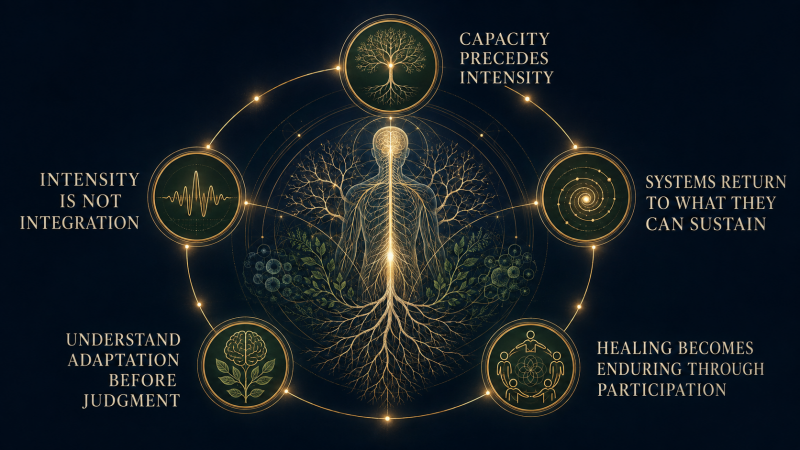
These principles reflect a central understanding within FSRT: meaningful change cannot be forced beyond what a person’s system has the capacity to sustain.
Intense experiences may create temporary openings, but enduring healing develops through understanding the intelligence of adaptation, building supportive conditions, and participating repeatedly in new ways of living until greater flexibility, connection, and regulation become sustainable.
Because FSRT is concerned with what can be lived and sustained, it must remain open to examination, refinement, and dialogue. The framework is therefore held not as a fixed doctrine or claim to authority, but as an evolving body of work requiring careful and responsible stewardship.
Stewardship Rather Than Authority
Alan occupies this work as both its originator and its steward. His role is not to stand above the theory or present it as a finished doctrine. His responsibility is to articulate it carefully, test its coherence, acknowledge its limitations, and allow it to develop through clinical application, dialogue, critique, and continued learning.
FSRT does not ask to be accepted because of credentials, professional status, or authority. It invites evaluation through ethical restraint, conceptual coherence, clinical usefulness, and its ability to help people understand suffering without reducing the person to the suffering they carry.
The framework will continue to evolve as its ideas are applied, questioned, refined, and brought into conversation with clinicians, researchers, practitioners, and people with lived experience.
An Invitation to Participate
Functional Systems Regulation Theory™ is not intended to create another rigid system around human experience. It offers an orientation: a way of seeing people within the full ecology of their lives.
It asks clinicians and communities to become more curious about what distress may be communicating, more careful about labeling adaptive responses as dysfunction, and more attentive to the conditions required for genuine change.
FSRT begins with a simple commitment: Assume intelligence before dysfunction.
From there, the work is to understand what the system has been carrying, what it has been protecting, what it has learned to expect, and what must become possible for a different pattern of living to emerge.
The purpose is not to perfect the individual. The purpose is to help create the conditions in which greater participation, flexibility, connection, and wholeness can become sustainable.

The Life Within the Theory
FSRT was not developed from clinical observation alone. The questions at its center were shaped through my own encounters with recovery, psychological suffering, altered states, medicine work, and the systems created to care for people in distress. I have known these systems from more than one position, as a person seeking help, as a participant in recovery, as a clinician, and as someone accompanying others through experiences that do not always fit neatly within conventional explanations.
These experiences taught me that a person can understand a pattern intellectually and still remain unable to change it. Insight can be genuine without becoming embodied. A transformative experience can reveal something essential without altering the conditions to which a person must return. A symptom can cause significant suffering while also performing an intelligent and necessary function within the larger system. What appears contradictory when viewed from the outside often becomes coherent when understood from within the life that produced it.
My personal and professional experiences have also shown me both the value and the limitations of systems of care. Diagnosis, medication, psychotherapy, treatment programs, recovery communities, and medical interventions can each provide essential support. They can also become incomplete when the person is separated from their history, relationships, body, environment, meaning, and the conditions that continue to shape their regulation. FSRT emerged partly from the need to hold these dimensions together without dismissing the contributions of any one discipline.
Medicine work further deepened these questions. Altered states can create profound openings, loosening familiar structures and allowing new forms of awareness, emotion, memory, and connection to become accessible. Yet access alone does not guarantee reorganization. People often return from significant experiences to the same relational patterns, environmental pressures, physiological burdens, and institutional realities that shaped them before. The experience may reveal what is possible, but the surrounding system influences what can be lived and sustained.
I did not develop FSRT from a place outside of suffering, adaptation, or change. The framework has been shaped through participation in the same living processes it attempts to describe. This does not grant it special authority, nor does personal experience substitute for evidence, dialogue, or critical examination. It does, however, locate the work honestly. FSRT emerged from a life lived within the questions, and from an ongoing effort to understand why human beings can encounter moments of profound possibility while still struggling to make those possibilities durable within ordinary life.
A Convergence of Disciplines
Functional Systems Regulation Theory™ emerged in conversation with multiple clinical, philosophical, scientific, and contemplative traditions. Each contributed an important way of understanding human experience, yet no single discipline adequately captured the full interaction of body, mind, relationship, environment, meaning, and participation that FSRT sought to describe. The framework developed not by combining these traditions into a unified technique, but by attending to the questions that continued to remain between them.
Internal Family Systems contributed a respectful understanding of multiplicity and the recognition that behaviors commonly regarded as dysfunctional may be organized around protection. From this perspective, conflicting impulses do not necessarily indicate internal disorder. They may reflect different parts of a person attempting to preserve safety, attachment, control, belonging, or continuity under difficult conditions. FSRT extends this adaptive curiosity beyond the internal world, asking how protective patterns are also shaped and sustained by the larger relational and environmental systems surrounding the person.
Trauma theory, nervous-system research, and somatic approaches helped clarify that human experience is not organized through thought alone. Memory, threat, attachment, and adaptation are carried through physiological states, bodily expectations, sensory responses, and patterns of activation or collapse. These traditions reinforced the importance of capacity, pacing, and embodied regulation. They also helped illuminate why insight or intention may be insufficient when the body continues to anticipate danger.
Depth and Jungian psychology contributed an appreciation for symbolism, contradiction, unconscious processes, and the dimensions of experience that cannot always be reduced to literal explanation. They opened space for understanding suffering not only as a problem to eliminate, but sometimes as a confrontation with meaning, identity, development, loss, or transformation. FSRT carries this respect for depth while remaining attentive to the biological, relational, and material conditions in which symbolic experience occurs.
Addiction treatment and recovery work revealed the limits of separating behavior from function and context. Substance use can be destructive while also serving as an attempt to regulate pain, disconnection, physiological distress, traumatic activation, or an intolerable environment. Recovery further demonstrates that stopping a behavior is not the same as creating a life capable of sustaining its absence. FSRT was shaped by this distinction between interruption and reorganization, and by the recognition that enduring change requires new capacities, relationships, roles, rhythms, and conditions of participation.
Ketamine-assisted psychotherapy, psychedelic therapy, and other forms of medicine work brought these questions into sharper focus. Altered states may loosen entrenched patterns and allow experiences of connection, insight, emotional access, or expanded awareness. They can reveal possibilities that ordinary consciousness has been unable to reach. Yet they also demonstrate that access is not the same as integration. The significance of an experience depends partly on whether the person and the surrounding system can receive, embody, and sustain what became available.
Systems theory, ecology, and complexity offered language for understanding that living systems are nested, interdependent, adaptive, and continually changing. A person influences and is influenced by relationships, families, communities, institutions, environments, histories, and systems of meaning. Change in one part of this field may create movement elsewhere, while stability within the larger system may resist or absorb individual change. FSRT draws upon this systemic orientation in proposing that regulation is not located entirely within the individual, but emerges through participation in a larger Living Field.
Indigenous and contemplative traditions have long understood dimensions of relationship, reciprocity, interdependence, embodiment, and participation that modern clinical systems often divide into separate categories. FSRT approaches these traditions with respect and without claiming to represent, translate, or absorb them into a Western clinical model. Their influence is acknowledged as part of a broader recognition that the isolated individual is not the only, or necessarily the most complete, unit through which human experience can be understood.
FSRT is not a repackaging of any one of these traditions, nor does it claim authority over them. It is a distinct framework shaped through sustained engagement with the places where their insights converge, diverge, and leave important questions unanswered. Its contribution lies in organizing those questions around regulation, adaptation, capacity, participation, and the conditions required for change to become sustainable across the whole living system.

From Framework to Practice
Functional Systems Regulation Theory™ is being developed as more than a conceptual explanation of human experience. Its purpose is not only to offer a different way of understanding distress, but to influence how people are assessed, how clinical decisions are made, how therapeutic work is paced, and how change is supported beyond moments of insight or intervention.
The written foundation of FSRT is being established through a developing series of publications. Healing Beyond the Limits of the Isolated: Functional Systems Regulation Theory, Volume I: Orientation introduces the framework’s central concerns and offers an initial shift from isolated pathology toward regulation within living systems. Subsequent volumes are intended to deepen its theoretical foundations, clarify its concepts, and examine the clinical and ethical implications of working from a systems-based understanding of human experience.
Alongside these publications, FSRT is being translated into clinical principles that can guide practice. These include honoring regulation before interpretation, assuming intelligence before dysfunction, increasing participation before intensity, and recognizing that systems return to what they have the capacity and support to sustain. Such principles are intended to shape clinical judgment rather than prescribe a rigid sequence of interventions.
The FSRT clinical process is organized across five overlapping phases: Entry and Assessment, Stabilization and Containment, Meaning Making and Pattern Recognition, Reorganization and Skill Integration, and Coherence and Participation. These phases recognize that healing rarely unfolds in a straight line. A person may move forward, return to earlier needs, or require renewed stabilization as circumstances change. The phases provide orientation while preserving responsiveness to the individual and the Living Field in which the work occurs.

The FSRT Integration Index™ is also being developed as a structured clinical assessment instrument. Its purpose is to examine regulation across biological, psychological, relational, behavioral, environmental, and participatory domains while assessing both burden and existing capacity. Rather than measuring only the presence or severity of symptoms, the Index is designed to help identify how patterns function, where strain is accumulating, what supports are available, and what conditions may be necessary before deeper work can be approached safely.
Practical applications of FSRT are being explored within individual psychotherapy, trauma treatment, addiction and recovery, ketamine-assisted psychotherapy, psychedelic preparation and integration, and other contexts involving significant changes in consciousness, identity, behavior, or relationship. Across these applications, the central question remains consistent: not only what became possible during an intervention, but what can be embodied, practiced, and sustained within ordinary life.
These materials remain in development and will require continued clinical application, critical review, refinement, and appropriate research. FSRT is not being presented as a completed system or a substitute for established standards of care. It is being built as a practical and evolving framework that can help clinicians and participants understand where change is occurring, where it remains unsupported, and what the larger system may require for healing to become durable.
An Evolving Body of Work
Functional Systems Regulation Theory™ is taking form through an expanding body of publications, clinical principles, assessment instruments, and educational materials. Each part of the work serves a different purpose, from establishing the framework’s conceptual foundations to translating its ideas into forms that can be examined, applied, questioned, and refined.
Healing Beyond the Limits of the Isolated: Functional Systems Regulation Theory - Volume I
Published July of 2026 - Purchase the work by following the link below
Healing Beyond the Limits of the Isolated: Functional Systems Regulation Theory - Volume I introduces the central shift underlying FSRT: human suffering cannot always be understood adequately when regulation is located entirely within the individual.
The book examines how human experience emerges through interaction among biological, psychological, relational, environmental, social, and meaning-making systems. It invites readers to reconsider symptoms not only as signs of internal dysfunction, but as adaptations that may reflect the intelligence of a person attempting to survive, preserve connection, regulate distress, or remain functional within the conditions of their life.
Volume I establishes the orientation, language, and foundational questions of FSRT. It is not intended to present a completed theory or rigid clinical method. Instead, it opens a broader inquiry into where distress is located, what patterns may be protecting or preserving, and what conditions are required for meaningful change to become sustainable.
The Constitutional Foundations of FSRT: The Living Field
Currently in Development
The Constitutional Foundations of FSRT: The Living Field develops the deeper theoretical architecture of the framework. It examines the Living Field as the interconnected biological, psychological, relational, social, environmental, institutional, and meaning-making systems through which human experience is continuously formed.
This volume expands the foundational proposition of FSRT, defines its central concepts, and establishes the principles and clinical commitments that guide the work. It further explores regulatory burden, homeostatic patterning, adaptive intelligence, sacred distress, integration as participation, and the relationship between temporary change and sustainable reorganization.
The FSRT Integration Index™
Currently in Development
The FSRT Integration Index™ is a structured clinical assessment instrument being designed to examine regulation across multiple interacting areas of life. Its purpose is to assess not only symptoms and dysfunction, but also capacity, participation, flexibility, available support, adaptive function, and the conditions surrounding a person’s current patterns.
The Index is intended to help clinicians and participants identify where regulatory burden is accumulating, what a pattern may be protecting or preserving, which capacities are already present, and what conditions may need to change before deeper therapeutic work can be approached or sustained. It remains in development and will require continued testing, clinical review, refinement, and appropriate validation.
Clinical and Educational Materials
Ongoing Development
Future FSRT materials will translate the theory into practical resources for clinicians, participants, educators, and communities. These may include clinical guidance, assessment resources, reflective exercises, preparation and integration materials, case formulations, training programs, and tools for examining how regulation operates across the Living Field.
Applications are being explored within psychotherapy, trauma treatment, addiction and recovery, ketamine-assisted psychotherapy, psychedelic preparation and integration, and other settings involving significant changes in consciousness, identity, behavior, relationship, or participation.
A Framework Still Becoming
FSRT is not being presented as complete. Its current body of work represents a foundation from which further dialogue, application, critique, research, and refinement can occur. New materials will be developed carefully, with attention to clinical usefulness, ethical responsibility, conceptual coherence, and the limits of what the framework can presently claim.
The work will continue to evolve, but its central commitment will remain consistent: to understand human suffering within the living systems that shape it, and to help create conditions in which greater regulation, flexibility, connection, and participation can become sustainable.
An Invitation to Participate
Functional Systems Regulation Theory™ is not intended to remain the work of one person or become a closed system protected from examination. If it is to develop with integrity, it must enter into relationship with the people who encounter it, apply it, question it, and recognize both its usefulness and its limitations.
Clinicians are invited to consider how FSRT may shape assessment, formulation, pacing, and the interpretation of symptoms. Researchers are invited to examine its propositions, identify what can be investigated, and challenge what remains unclear or unsupported. Educators and practitioners are invited to explore how the framework may inform preparation, integration, recovery, and other processes of change.
People with lived experience hold an equally important place in this work. A theory concerned with human suffering cannot be developed responsibly without listening to those whose lives have been interpreted, diagnosed, treated, helped, harmed, or misunderstood by systems of care. Lived experience is not simply material for professional analysis. It is a form of knowledge that can reveal what clinical language overlooks and what institutional perspectives cannot see from the outside.
Engagement with FSRT does not require agreement. Thoughtful critique, disagreement, and revision are necessary if the framework is to become more precise, ethical, and useful. The purpose is not to gather followers around a fixed theory, but to create a field of inquiry capable of holding complexity without losing sight of the person living within it.
If these ideas intersect with your clinical work, research, lived experience, or understanding of healing, you are invited to enter the conversation. Read the work carefully. Test its coherence. Notice where it clarifies experience and where it remains incomplete. Bring forward the questions that the framework has not yet learned to ask.
FSRT begins with the recognition that no person exists in isolation. Its continued development must honor that same truth.
The work does not ask to be believed. It asks to be examined, lived, questioned, and developed through participation.
FSRT begins with the recognition that no person exists in isolation. Its continued development must honor that same truth.
The work does not ask to be believed. It asks to be examined, lived, questioned, and developed through participation.
Continue the Conversation
FSRT will continue to develop through clinical application, lived experience, thoughtful critique, and dialogue across disciplines. If the framework intersects with your work, research, or understanding of healing, you are invited to share your perspective and participate in its continued development.
If you would like to share a perspective, ask a question, or explore how your work may intersect with FSRT:
Read the Published Foundation
Explore the book in which the foundational orientation of Functional Systems Regulation Theory was first presented:
Healing Beyond the Limits of the Isolated: Functional Systems Regulation Theory, Volume I: Orientation
Not all suffering is pathology. Sometimes suffering is initiation.

Author
Alan Romano, LCSW
Founder, Psycholytic Services
Creator of Functional Systems Regulation Theory