
Medicine Across Phases: Medicine as Scaffold, Not Solution
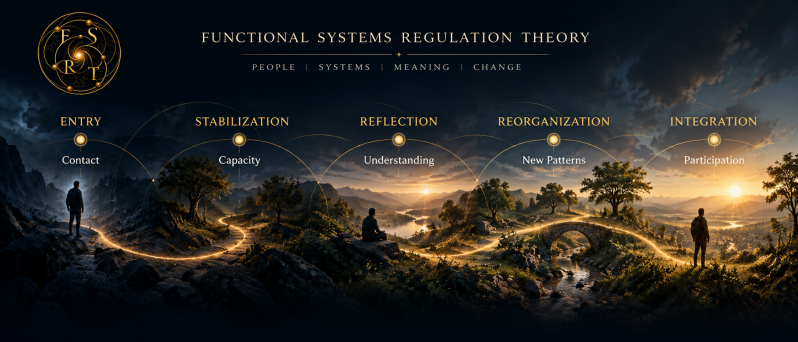
Functional Systems Regulation Theory approaches medicine-assisted psychotherapy through the same principles that organize the broader clinical framework: capacity, attunement, containment, context, and integration. Medicines are not treated as cures, shortcuts, catalysts by default, or fixed stages within a healing process. They are understood as interventions introduced into a living system whose effects depend upon the conditions surrounding their use.
A medicine may alter perception, reduce defensive rigidity, increase emotional access, interrupt established patterns, or temporarily make new states available. None of these effects, by themselves, constitute healing or reorganization. What matters is whether the system can metabolize what the intervention introduces and sustain what becomes possible after the acute experience has passed.
The same medicine may therefore function differently across people, contexts, and phases of the clinical arc. An intervention that supports regulation under one set of conditions may exceed capacity under another. An experience that facilitates access may still require substantial relational, environmental, and integrative support before it contributes to durable change.
FSRT does not organize care around substances. It organizes care around system capacity.
The central question is therefore not Which medicine belongs in which phase? It is:
What function might this intervention serve here, and can this system metabolize what it introduces?
What follows is not a treatment protocol, prescribing guide, or universal endorsement of any particular medicine. It is a systems-oriented map for considering how medicine-assisted interventions may function differently as regulatory conditions change across the FSRT Clinical Arc.
Phase One: Entry and System Assessment
Orientation Before Depth
In the initial phase, the central question remains the same as it is throughout Entry and System Assessment:
Is there enough safety for contact?
Medicine work, when considered at all, remains secondary to understanding the system. The clinical priority is not depth, catharsis, or accelerated access, but establishing whether sufficient relational, physiological, and environmental conditions exist for meaningful contact.
An intervention that reduces overwhelming activation or creates temporary distance from rigid defensive patterns may, in some circumstances, support orientation. But increased access is not automatically beneficial. If an intervention introduces more material, intensity, or physiological demand than the system can metabolize, it may interfere with the very conditions the phase is attempting to establish.
FSRT therefore approaches medicine conservatively at entry. The question is not how deeply an intervention can take the person, but whether its function supports contact, orientation, and assessment without exceeding capacity.
Early medicine work, when present, supports orientation rather than depth.
Phase Two: Stabilization and Capacity
Medicine as Temporary Regulatory Scaffold
As safety, predictability, and relational contact become more available, medicine-assisted work may sometimes serve a regulatory function. An intervention may temporarily reduce perceived threat, interrupt rigid patterns of activation, or allow experiences of rest, connection, or emotional contact that have been difficult to access without support.
Within FSRT, these experiences are understood as borrowed capacity rather than evidence of completed change. A temporary state of regulation can be clinically meaningful because it gives the system an experience from which learning may occur. But the intervention does not own that learning, and the state itself should not be confused with structural reorganization.
Attunement therefore remains central. Timing, intensity, relational support, preparation, and what happens after the intervention matter as much as the intervention itself.
The goal is not to maintain regulation through repeated medicine exposure. It is to support conditions through which regulatory capacity can increasingly become available beyond the intervention.
Regulation may be borrowed before it becomes self-sustaining.
Phase Three: Meaning-Making and Pattern Recognition
Access Without Overload
As the system develops greater capacity for reflective awareness, medicine-assisted experiences may support emotional access, perspective shifting, symbolic material, or greater flexibility around established narratives and patterns.
FSRT does not equate increased access with therapeutic progress. Material becoming available does not mean the system is prepared to integrate it. Profound insight, emotional intensity, autobiographical memory, or altered perspective may be meaningful while still exceeding the capacity available to metabolize what has emerged.
Attunement therefore shifts toward the relationship between access and integration. The clinician attends not simply to what becomes visible, but to what happens when the person returns to ordinary states, relationships, environments, and demands.
The question becomes:
Can what has become accessible be held, understood, and integrated without becoming another source of dysregulation?
Within FSRT, insight is valuable to the extent that the system can metabolize it.
Phase Four: Reorganization and Skill Integration
From State Change to Structural Change
As regulation, insight, and experiential access converge, medicine-assisted work may support periods of reorganization. New emotional responses, relational experiences, meanings, or ways of encountering previously threatening material may become temporarily available.
But FSRT distinguishes state change from structural change.
A powerful therapeutic or altered-state experience can demonstrate that another organization is possible without establishing that organization as durable. Reorganization occurs through what follows: repetition, relational experience, behavioral practice, environmental support, integration, and the system's increasing ability to maintain new responses when familiar stressors return.
Medicine may therefore function as a scaffold for reorganization, but it cannot substitute for the processes through which reorganization becomes sustainable. The central question becomes:
Can what became possible during the intervention remain available when the conditions that once organized the old pattern return?
Phase Five: Coherence and Participation
Medicine Without Dependence
As coherence and participation become more sustainable, medicine work, when present, becomes increasingly contextual rather than central. An intervention may occasionally support reflection, recalibration, meaning-making, or navigation of significant transitions, but continued development is not understood as dependent upon continued medicine use.
The measure of change is increasingly visible outside the therapeutic or altered state: in relationships, responses to disruption, flexibility under stress, meaningful participation, and the person's capacity to remain connected to self and others across changing conditions.
This does not require the permanent absence of support. FSRT does not equate healing with independence. Rather, the nature of support changes as the system develops greater capacity to participate without relying upon a particular intervention to make regulation possible.
The medicine becomes less central as the capacities it helped reveal become more available in ordinary life.
The Medicine Does Not Define the Phase
A particular medicine does not belong inherently to a particular FSRT phase. The same intervention may serve different functions under different conditions, and its appropriateness cannot be determined from phase alone.
What matters is the relationship among the intervention, the individual, the therapeutic relationship, the surrounding environment, the system's current regulatory burden, and the capacity available for integration.
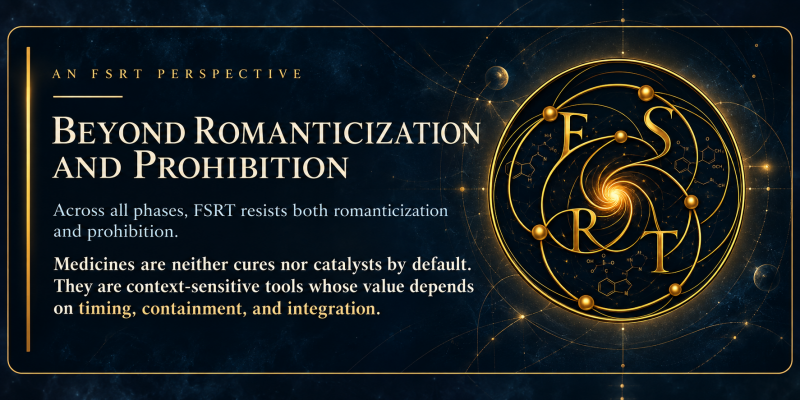
This is why FSRT resists both the romanticization and prohibition of medicines as categories. Medicines are neither inherently healing nor inherently destabilizing. Their clinical meaning emerges through function, timing, context, containment, and what the system is able to sustain afterward.
The Intervention Is Not the Healing
Medicine can alter access, intensity, perception, affect, and state. It may interrupt established patterns or reveal possibilities that were previously inaccessible. These experiences can be meaningful, sometimes profoundly so. But none of them alone constitute reorganization.
The clinically meaningful question is what happens after the state changes.
Can the experience be metabolized? Can insight become embodied rather than merely remembered? Can a new relational experience alter what becomes possible in relationship? Can regulatory capacity remain available when familiar stressors return? Can change survive contact with ordinary life?
FSRT therefore returns medicine-assisted work to the same principle that organizes the entire clinical arc: The intervention is not the healing. The developing capacity of the system is.
From Clinical Application to the FSRT Vault
The clinical framework establishes how FSRT approaches capacity, intervention, and reorganization. The FSRT Vault extends these questions beyond the clinical arc through essays exploring trauma, psychedelic experience, relationship, spirituality, culture, regulation, and the broader conditions that shape human change.
Author
Alan Romano, LCSW
Founder, Psycholytic Services
Creator of Functional Systems Regulation Theory