
Emotional Regulation and the Organization of Capacity
An FSRT perspective on emotional intensity, regulatory capacity, adaptation, and the ability to remain in relationship with experience

Emotional dysregulation is often understood as difficulty managing emotional responses: emotions may become unusually intense, persist longer than expected, shift rapidly, or contribute to behaviors that feel difficult to control. Functional Systems Regulation Theory (FSRT) begins from a different question. Rather than asking only why a person cannot regulate an emotion, FSRT asks what is happening across the living system when the demands of an emotional experience exceed the capacity currently available to meet them.
From this perspective, emotional dysregulation is not simply the presence of too much emotion or evidence that an individual has failed to regulate effectively. It can emerge when the intensity, complexity, or meaning of an experience exceeds what the system can presently organize while maintaining sufficient connection to the body, relationships, environment, identity, and present moment. What appears externally as overreaction, shutdown, impulsivity, avoidance, or emotional instability may represent different attempts by the system to respond when its available regulatory capacity has been exceeded.
This distinction matters because emotional intensity and regulatory capacity are not the same thing. A powerful emotional response can occur within a well-regulated system, just as an apparently calm person can be relying heavily on suppression, dissociation, withdrawal, or control to maintain stability. Regulation therefore cannot be measured simply by how calm someone appears or by how quickly an uncomfortable emotion disappears.
Within FSRT, emotional regulation is better understood as the capacity to remain sufficiently organized in relationship with experience. This may include feeling fear without becoming entirely organized around threat, experiencing anger without losing access to choice, encountering grief without needing to escape it, or allowing joy and vulnerability without immediately constricting around what might follow. Regulation does not require the absence of emotional movement. It requires enough capacity for that movement to occur without the system losing access to flexibility, connection, and participation.
The Living Field is central to this process. Emotional capacity develops and operates within biological, developmental, relational, environmental, cultural, and meaning-making conditions. A system that has repeatedly encountered emotional experiences without adequate safety, support, predictability, or co-regulation may learn that certain states are difficult or dangerous to sustain. Conversely, relationships and environments that provide sufficient containment can expand what the system learns it is capable of experiencing.
From this perspective, dysregulation is not necessarily evidence that the emotion itself is the problem. It may indicate that the relationship between what the system is being asked to experience and what it currently has the capacity to sustain has become mismatched.
This leads to a central FSRT question:
What does this system need in order to remain in relationship with what it is feeling?
Regulation Is Not Emotional Control
Emotional regulation is often associated with the ability to calm down, reduce emotional intensity, or prevent feelings from influencing behavior. These abilities can be valuable, but from an FSRT perspective, regulation cannot be defined simply by how effectively a person controls what they feel. A system can appear calm while using substantial energy to suppress, contain, disconnect from, or avoid an emotional experience.
This distinction becomes important when outward stability is mistaken for internal regulation. A person may speak calmly while experiencing intense physiological activation, intellectualize an experience rather than feel it, withdraw from relationships that evoke vulnerability, remain constantly productive to avoid contact with distress, or suppress anger because expressing disagreement has historically threatened connection. These strategies may help maintain organization, and at times they may be necessary. But the absence of visible emotional intensity does not necessarily mean the system is regulating with ease.
From an FSRT perspective, regulation is less about controlling emotional experience and more about maintaining sufficient organization while emotional experience is occurring. The person does not need to eliminate fear in order to remain present with it, resolve sadness before continuing to participate in life, or suppress anger in order to retain access to choice. The emotional state can remain present while the system continues to access awareness, relationships, context, meaning, and behavioral flexibility.
This also means that dysregulation should not be defined by intensity alone. Crying intensely, experiencing profound grief, feeling anger, or becoming temporarily overwhelmed may all occur within the range of healthy human experience. The more relevant question is what happens to the organization of the system as intensity increases. Does the person retain some capacity for awareness and choice? Can connection remain available? Can the system eventually move through the experience and reorganize, or does it become increasingly dependent upon escape, suppression, shutdown, or other protective responses in order to restore stability?
FSRT therefore shifts the goal from emotional control toward regulatory flexibility. Regulation does not require remaining calm. It involves developing enough capacity for a wider range of emotional experience to become tolerable, meaningful, and sustainable without requiring the system to organize its life around preventing those emotions from occurring.
The aim is not to feel less.
It is to expand what the system can feel without losing access to itself.
The Living Field and Emotional Capacity
Emotional capacity does not develop in isolation. From an FSRT perspective, the ability to experience, organize, and move through emotion develops within the Living Field: the continuously interacting biological, psychological, relational, developmental, social, environmental, cultural, and meaning-making conditions through which a person learns what can be safely experienced and sustained.
Early relationships can play an important role in this process. Before a person develops the ability to independently recognize and organize complex emotional states, regulation often occurs in relationship with others. Experiences of being comforted, understood, protected, ignored, criticized, overwhelmed, or required to manage emotion alone can contribute to what the developing system learns about emotional experience. Some emotions may become associated with connection, while others become associated with conflict, rejection, vulnerability, unpredictability, or loss of control.
Over time, these experiences can influence the emotional range within which the system has learned to remain organized. A person may become highly capable of functioning under pressure while struggling to tolerate vulnerability. Another may readily experience sadness but have difficulty accessing anger. Someone else may feel comfortable caring for others while becoming dysregulated when their own needs require attention. These patterns do not necessarily reflect an inability to feel. They may reflect what the system has learned it can safely experience while maintaining connection, identity, and stability.
The Living Field also remains active in the present. Regulatory capacity can change depending upon relationships, physical health, sleep, stress, financial pressure, work demands, social support, environmental safety, and the accumulation of other demands placed upon the system. An emotional experience that is manageable under one set of conditions may become overwhelming when available capacity has already been consumed elsewhere. In this sense, dysregulation cannot always be understood by examining the emotion alone. The same emotional intensity may be sustainable at one moment and exceed available capacity at another.
This is why FSRT does not treat regulatory capacity as a fixed personal trait. Capacity is dynamic, relational, and responsive to conditions across the Living Field. It can narrow under sustained burden and expand through experiences of safety, support, practice, meaning, and successful contact with emotional states that were previously difficult to sustain.
The question therefore shifts from asking “Why can't this person handle their emotions?” toward asking:
“What conditions have shaped what this system has learned it can feel, and what conditions might allow that capacity to expand?”
When Emotion Exceeds Available Capacity
Emotional experiences place demands upon the living system. Fear may require the system to orient toward potential danger. Grief may require contact with loss while continuing to navigate a world in which something meaningful is no longer present. Anger may mobilize energy toward protection, boundary formation, or action. Shame may alter how the person experiences themselves in relationship with others. Even emotions typically understood as positive, such as joy, intimacy, excitement, or love, can create significant activation and vulnerability.
From an FSRT perspective, the intensity of these experiences does not determine whether dysregulation occurs. What matters is the relationship between the demands of the experience and the capacity available to meet those demands.
When sufficient capacity is available, an emotion can become intense without requiring the entire system to reorganize around it. Fear can be experienced while the person remains aware of present conditions. Anger can mobilize without eliminating access to reflection or choice. Grief can become profound without permanently severing connection to relationships, meaning, or participation. The emotion may temporarily occupy significant space within experience, but other aspects of the system remain accessible.
When emotional demand exceeds available capacity, however, the system may need to reorganize in order to remain functional. Attention may narrow. Physiological activation may increase or collapse. Thinking may become rigid or fragmented. Impulses toward escape, control, confrontation, withdrawal, numbing, or dissociation may become stronger. Access to relational connection can diminish, and the emotional state itself may begin to feel indistinguishable from reality.
These responses are often described clinically as symptoms of dysregulation. FSRT does not deny that they can become distressing, disruptive, or dangerous. It does, however, invite the clinician to first consider their regulatory function. If remaining fully present with an emotional experience exceeds what the system can currently sustain, reducing contact with that experience may represent an attempt to preserve organization rather than evidence that the system has simply failed.
This is where the FSRT principle assume intelligence before dysfunction becomes particularly important. Avoidance may create distance from an experience that feels unmanageable. Dissociation may reduce contact with overwhelming internal information. Anger may mobilize the system when vulnerability feels unsafe. Intellectualization may create cognitive distance from emotion. Withdrawal may reduce relational and environmental demand. None of these responses should automatically be romanticized or preserved simply because they developed for a reason. They can become costly and restrictive. But understanding what they accomplish for the system changes how we approach them.
If a protective response is removed before the system has developed another way to meet the demand it was managing, the person may be left with greater exposure but no greater capacity.
For this reason, FSRT does not begin by asking how quickly an emotional response can be eliminated. It asks what the response is helping the system accomplish, what emotional demand lies beneath it, and whether sufficient capacity exists for the system to encounter that experience differently.
The question is not simply how intense the emotion is, but whether the system has sufficient capacity to remain organized in relationship with it.
When Protection Becomes Regulation
When an emotional experience repeatedly exceeds available capacity, the system may begin to rely upon whatever responses have successfully reduced that demand in the past. What initially emerged as protection in a particular moment can gradually become part of how the person regulates emotional experience more broadly.
A child who learns that expressing anger threatens connection may discover that suppressing anger helps preserve important relationships. Someone whose vulnerability has repeatedly been met with rejection may learn to withdraw before needing another person becomes visible. A person who has experienced overwhelming fear may develop increasingly elaborate forms of preparation and control. Someone who discovers that intellectualizing painful experiences makes them easier to tolerate may become highly skilled at understanding emotion without necessarily remaining in contact with it.
These responses can work. Suppression can reduce conflict. Withdrawal can reduce relational demand. Control can decrease uncertainty. Intellectualization can create distance from overwhelming affect. Dissociation can reduce the amount of internal information reaching conscious awareness. Each may help the system remain within a range it has learned it can sustain.
From an FSRT perspective, this is an important distinction. Protection does not exist outside regulation. Protection can become a method of regulation.
Difficulty can emerge when the system becomes increasingly dependent upon a limited set of protective strategies to maintain stability. What once helped regulate a particular emotional experience may begin organizing relationships, behavior, identity, and participation more broadly. Avoiding conflict may gradually become difficulty establishing boundaries. Emotional independence may become difficulty receiving support. Preparation may become chronic control. Withdrawal may protect against rejection while simultaneously reducing opportunities for intimacy and connection.
The protective strategy has not necessarily stopped working. In many cases, it continues to accomplish precisely what the system learned it could accomplish. The problem is that maintaining protection may begin to require increasingly greater restriction elsewhere in the Living Field.
This is why simply removing a protective response can be insufficient. Asking someone to become vulnerable, stop avoiding, relinquish control, express anger, or remain present with distress may expose the system to the very experiences those patterns developed to regulate. Without additional capacity, the request for change can become another demand placed upon an already burdened system.
FSRT therefore approaches protective patterns with curiosity before correction. The clinical task is not merely to identify what the person should stop doing, but to understand what becomes difficult to sustain when that protection is no longer available.
Change becomes possible as the system develops additional ways of meeting the underlying emotional demand. Protection no longer has to disappear in order for flexibility to increase. Instead, the system can gradually discover that it has more than one available response. What was once necessary can become optional. And when protection becomes optional rather than automatic, the range of possible emotional experience begins to expand.
Homeostatic Patterning and the Familiar Emotional Range
Over time, repeated regulatory responses can become familiar ways of organizing emotional experience. FSRT describes this through Homeostatic Patterning: the tendency of living systems to return toward organizations they have learned they can sustain.
This does not mean the system necessarily returns to what feels good, healthy, or comfortable. It returns toward what is familiar enough to organize around. An emotional pattern can therefore be painful while still serving as a form of regulatory familiarity.
This becomes particularly important when considering emotional dysregulation. People do not only develop familiar behaviors in response to emotion; they can also develop a familiar range of emotional experience within which the system has learned to function. Certain emotions, levels of activation, forms of vulnerability, or degrees of relational closeness may remain relatively accessible, while others quickly activate protective responses.
For one person, anger may be familiar while sadness feels intolerably vulnerable. For another, sadness may be accessible while anger threatens an identity organized around being agreeable or safe. Some people may tolerate crisis remarkably well yet become uncomfortable when life becomes quiet. Others may long for intimacy while finding the emotional exposure of closeness increasingly difficult to sustain. Even experiences such as joy, success, affection, rest, or being cared for can exceed a familiar regulatory range when the system has had limited opportunity to organize around them.
This helps explain why meaningful emotional experiences do not always produce lasting change. A person may have a powerful therapeutic session, experience unexpected vulnerability in a relationship, establish a boundary for the first time, or enter an altered state in which previously inaccessible emotions become available. The experience may be genuine and significant. Yet once the intensity of the moment passes, familiar patterns can gradually reassert themselves.
From an FSRT perspective, this does not mean the experience was unsuccessful. It means access is not the same as capacity.
A person can temporarily access an emotional state that the broader system has not yet learned to sustain. Insight may occur before relationships change. Vulnerability may become possible before the person knows how to navigate what follows it. Anger may become accessible before boundary-setting feels safe. Connection may be experienced before the Living Field contains enough support for connection to remain available.
The system may therefore return toward familiar organization, not because it is resisting healing, but because familiar organization remains more sustainable than what has only briefly become possible.
This is one reason FSRT places such importance on Integration as Reorganization. The goal is not simply to produce increasingly intense emotional experiences or repeatedly push beyond familiar limits. It is to help what becomes possible through therapy, relationships, insight, or other meaningful experiences gradually become more available within everyday life.
As capacity expands, the familiar emotional range can expand with it. Experiences that once required immediate protection may become increasingly tolerable. The system may discover that anger does not always destroy connection, vulnerability does not always lead to rejection, sadness can be experienced without collapse, and closeness does not always require the loss of autonomy.
The objective is not to replace one emotional state with another.
It is to increase the range of experience the system can encounter without losing access to flexibility, connection, and choice.
Regulatory Burden and the Narrowing of Capacity
Regulatory capacity is not static. The amount of emotional intensity a person can sustain at one moment may be very different from what the same person can sustain under different conditions. From an FSRT perspective, this variability becomes easier to understand through Regulatory Burden: the accumulated demands already being carried by the living system.
Sleep disruption, physical illness, chronic pain, financial uncertainty, caregiving responsibilities, relational conflict, occupational pressure, isolation, grief, environmental instability, and sustained exposure to uncertainty can all require regulatory resources. Individually, these demands may be manageable. As they accumulate, however, more of the system's available capacity may already be committed before an emotionally significant event even occurs.
This can help explain why a seemingly minor experience sometimes produces a disproportionately large response. The immediate event may be relatively small, but it does not arrive within an empty system. It enters a Living Field in which substantial regulatory work may already be taking place.
A disagreement with a partner may be manageable after a restorative week and overwhelming after several nights without adequate sleep. A change in plans may ordinarily produce mild frustration but trigger intense anxiety when the person is already managing financial pressure, family conflict, and uncertainty at work. A request from another person may feel reasonable under one set of conditions and intolerable when the system has spent days meeting the needs of everyone else.
Viewed only through the immediate event, these reactions can appear excessive. Viewed across the Living Field, the response may become more understandable. The issue is not necessarily that the person has suddenly lost the ability to regulate. The amount of capacity available for regulation may have changed.
As Regulatory Burden increases, the range within which the system can remain flexible may narrow. Emotional activation may occur more quickly. Recovery may take longer. Protective responses may become easier to trigger, and strategies such as withdrawal, control, avoidance, numbing, irritability, or dissociation may become increasingly necessary to reduce demand. Experiences that would ordinarily remain within capacity can begin exceeding it.
This also means that emotional dysregulation should not automatically be interpreted as evidence of regression. A person can develop substantial emotional capacity through therapy and still become dysregulated when demands across the Living Field exceed what can presently be sustained. Growth does not make a person infinitely capable of absorbing stress, adversity, or emotional intensity.
This distinction has important clinical implications. If treatment focuses exclusively on increasing the individual's ability to tolerate more, therapy can unintentionally become another source of regulatory demand. The person may be taught additional coping strategies, encouraged to tolerate greater distress, or asked to remain present with increasingly difficult material while little attention is given to the conditions continually consuming their available capacity.
Sometimes the work involves expanding capacity.
Sometimes it involves reducing unnecessary burden.
Often, it involves both.
FSRT therefore asks not only “How can this person regulate this emotion?” but also “What is this system already regulating before this emotion arrives?”
That question widens the clinical frame. It allows emotional dysregulation to be understood not only through the intensity of the present experience, but through the total demand being carried by the person within their Living Field.
Capacity Before Intensity
Many approaches to emotional healing involve moving toward experiences that have previously been avoided, suppressed, or difficult to tolerate. This can be important. Fear may need to be approached rather than continually escaped. Grief may need space to be felt. Anger may need to become accessible before boundaries can be recognized. Vulnerability may need to be encountered for deeper forms of connection to become possible.
FSRT does not argue against emotional depth or intensity. It asks whether the system has sufficient capacity to remain in relationship with what is being opened.
This distinction is captured in a central FSRT principle: capacity precedes intensity.
An experience does not become therapeutic simply because it is powerful. Emotional catharsis, traumatic memory retrieval, confrontation, exposure, somatic activation, or an altered state of consciousness may produce profound experiences, but intensity alone does not determine whether those experiences can be integrated. If the demands of the experience substantially exceed available capacity, the system may need to rely upon the same protective responses it has historically used to restore organization.
A person may leave a powerful therapeutic experience feeling temporarily open, connected, or transformed and still find familiar patterns returning in the days that follow. Another may access material so rapidly that the period afterward is characterized by increased anxiety, withdrawal, dissociation, relational instability, or difficulty functioning. Neither response necessarily means that the experience lacked value. It may indicate that what became available exceeded what the broader system could immediately sustain.
From an FSRT perspective, intensity is not integration.
This becomes particularly important in therapies that intentionally increase contact with difficult emotional material. The goal is not to determine how much emotion a person can endure. Nor is therapeutic progress measured by how deeply someone can be pushed into an experience. The more relevant question is whether the person can encounter meaningful emotional material while retaining enough organization for awareness, relationship, choice, and subsequent integration to remain available.
Capacity-building may therefore appear less dramatic than breakthrough experiences. It can involve learning to notice activation before becoming overwhelmed, remaining present with an emotion for slightly longer, asking for support instead of withdrawing, expressing a boundary without immediately repairing the other person's discomfort, tolerating uncertainty without resolving it, or allowing an emotional experience to exist without immediately needing to understand or eliminate it. These changes may appear small, but they can represent meaningful reorganization within the system.
Capacity also develops through what happens after intensity. The system needs opportunities to discover that an emotional experience can occur and be survived, that activation can rise and fall, that connection can remain available during distress, and that returning to regulation does not always require abandoning the experience that produced the activation. Repeated experiences of this kind can gradually alter what the system learns it is capable of sustaining.
This is why FSRT does not equate healing with continually expanding tolerance for greater and greater intensity. The purpose of increasing capacity is not to make a person capable of enduring unlimited emotional demand. It is to increase flexibility: the ability to encounter what is meaningful, recognize when something exceeds available resources, access support when needed, and move between activation, rest, connection, withdrawal, expression, and containment in ways that remain responsive to present conditions.
More feeling is not necessarily more healing. Capacity determines what can be encountered, integrated, and sustained.
From Emotional Control to Regulatory Flexibility
If emotional regulation is understood primarily as control, progress can easily become defined by reduction: less anxiety, less anger, less sadness, fewer emotional reactions, fewer moments of overwhelm. These changes may certainly accompany healing, but from an FSRT perspective, the reduction of emotional intensity is not sufficient evidence that greater regulatory capacity has developed.
A person can become less emotionally reactive by becoming more avoidant. Conflict can decrease because difficult conversations are no longer occurring. Anxiety can diminish because uncertainty has been increasingly eliminated from daily life. Anger can disappear because boundaries are no longer being recognized. Vulnerability can feel more manageable because relationships requiring vulnerability have been kept at a distance. In each case, distress may decrease while the person's range of participation simultaneously becomes narrower.
FSRT therefore places greater emphasis on regulatory flexibility: the ability of the system to respond differently depending upon what present conditions actually require.
Regulatory flexibility allows activation when activation is useful and rest when rest is needed. It allows withdrawal without making withdrawal permanent, connection without requiring the loss of boundaries, anger without requiring aggression, vulnerability without requiring complete exposure, and emotional containment without automatically becoming suppression. The goal is not to identify one ideal regulatory state and remain there. It is to increase the system's ability to move among states while maintaining sufficient access to awareness, choice, relationship, and context.
This distinction also changes how periods of dysregulation are understood. Greater capacity does not mean that a person will never become overwhelmed again. Loss, conflict, uncertainty, trauma, illness, exhaustion, and major life transitions can exceed the resources of even a highly adaptive system. Regulatory flexibility means that becoming dysregulated does not necessarily require remaining organized around dysregulation. The system may become activated, seek support, withdraw temporarily, recover, and gradually return to participation as conditions change and capacity becomes available again.
Healing, then, does not require the elimination of protective responses. A person may still need distance, distraction, containment, solitude, reassurance, structure, or control at different moments. The important change is that these responses become increasingly contextual rather than compulsory. The system develops more than one way of responding.
This is where flexibility differs from simply replacing an undesirable coping strategy with a preferred one. If a person becomes dependent upon a new strategy in exactly the same rigid way they depended upon the old one, the behavior may have changed without the underlying organization becoming substantially more flexible. Breathing exercises, mindfulness, cognitive reframing, exercise, journaling, meditation, or other regulatory practices can all be valuable, but no single strategy represents regulation in every circumstance.
FSRT is therefore less interested in whether someone is using the “correct” regulatory response than in whether the system has developed a broader range of responses that can be selected according to present conditions.
Over time, this can change the person's relationship with emotion itself. Fear no longer automatically requires escape. Anger does not always require suppression or discharge. Sadness does not necessarily signal collapse. Vulnerability does not inevitably require withdrawal. Emotional activation becomes information the system can encounter and respond to rather than something that must immediately be controlled.
The movement is subtle but significant.
The goal shifts from “How do I stop feeling this?”
toward:
“Can I remain in relationship with what I am feeling while still retaining access to myself, others, and the choices available to me?”
Integration as Reorganization
Within FSRT, this movement toward regulatory flexibility is part of Integration as Reorganization. Integration is not simply understanding why an emotional pattern exists, naming the emotion correctly, or having a powerful experience in which previously inaccessible feelings become available. These experiences may contribute to change, but lasting integration requires what becomes possible in one moment to become increasingly sustainable across the person's everyday Living Field.
A person may understand intellectually that anger is permissible while still becoming physiologically overwhelmed when conflict occurs. They may experience vulnerability within the safety of therapy while continuing to withdraw from intimacy outside the therapeutic relationship. They may recognize that rest is necessary while still experiencing guilt whenever productivity decreases. Insight has occurred, but the system may not yet be organized around what the person now understands.
Reorganization develops as new experiences are encountered repeatedly enough, and within sufficient capacity, for the system to discover that different responses can be sustained. The person does not simply know that an emotion can be tolerated. Their relationships, behavior, physiology, expectations, and sense of possibility increasingly begin to reflect that knowledge.
The question is therefore not only whether something new has been experienced, it is whether the Living Field can increasingly support the person in living from what has become possible.
Clinical Implications
Approaching emotional dysregulation through an FSRT lens changes the clinical question. Rather than beginning with “How do we reduce this reaction?”, the clinician can first become curious about how the reaction is organized, what demands it is responding to, and what function it may serve within the person's broader Living Field.
This begins with understanding the conditions surrounding dysregulation. What emotions become difficult to sustain? What happens as intensity increases? Which protective responses emerge? What does the person gain temporary relief from when those responses occur? What relational, environmental, physiological, or developmental conditions increase Regulatory Burden? Just as importantly, under what conditions does the person already demonstrate greater capacity?
This orientation encourages the clinician to assume intelligence before dysfunction. A behavior can be harmful, restrictive, or no longer well matched to present conditions while still containing regulatory intelligence. Avoidance may reduce exposure to overwhelming activation. Withdrawal may protect against relational demand. Anger may create distance when vulnerability feels unsafe. Control may provide predictability within environments historically experienced as unstable. Dissociation may reduce contact with internal experience when remaining fully present has exceeded available capacity.
Understanding function does not mean endorsing every protective response or avoiding change. It provides a more precise starting point for change. When the clinician understands what a pattern is accomplishing, treatment can focus not only on reducing the pattern but on developing additional capacity to meet the demand the pattern has been managing.
This also requires attention to pacing. If a person relies heavily upon avoidance, emotional suppression, intellectualization, or dissociation, rapidly removing those protections may increase exposure without increasing capacity. The individual may appear to be engaging more deeply in therapy while internally becoming increasingly overwhelmed. From an FSRT perspective, therapeutic intensity should therefore be considered in relationship to the system's ability to organize, recover, and integrate what is being encountered.
Capacity precedes intensity.
Clinical work may involve gradually increasing contact with difficult emotions while preserving access to grounding, relationship, awareness, and choice. It may involve helping a person recognize activation earlier, expanding emotional language, strengthening boundaries, developing tolerance for uncertainty, practicing relational repair, accessing co-regulation, or learning that an emotional state can rise and fall without requiring immediate action. For some individuals, the work may initially involve reducing Regulatory Burden before deeper emotional processing becomes sustainable.
The Living Field remains clinically relevant throughout this process. Not every episode of dysregulation originates in an internal deficit or an unresolved historical pattern. A person may be attempting to regulate within a relationship that remains unsafe, an environment that continually exceeds available resources, or circumstances that provide insufficient opportunity for rest, connection, autonomy, or support. In these situations, helping the individual tolerate more without examining what they are being asked to tolerate risks locating the entire problem within the person.
Clinical intervention can therefore occur across multiple levels. Sometimes the work involves increasing internal capacity. Sometimes it involves changing relational patterns, establishing boundaries, accessing resources, reducing demands, modifying environments, or recognizing that a particular situation is continuing to generate meaningful dysregulation. Often these processes occur together.
Progress may then become visible in ways that extend beyond symptom reduction. The person may recover more quickly after activation. They may recognize overwhelm before reaching crisis. They may ask for support earlier, remain present during disagreement, tolerate an emotion without immediately acting upon it, or choose temporary withdrawal without becoming disconnected indefinitely. They may discover that emotions previously experienced as dangerous can be encountered in smaller and increasingly sustainable ways.
The clinical aim is not to create a person who remains regulated regardless of what happens to them.
It is to support a living system in developing enough capacity and flexibility to respond to what happens without continually losing access to itself in the process.
Ketamine-Assisted Therapy and Emotional Regulation
Ketamine-assisted therapy may offer another pathway for working with emotional dysregulation, particularly when access to emotion has become constrained by patterns of avoidance, suppression, control, dissociation, or other forms of protective organization. For some individuals, the ketamine experience may temporarily alter the usual relationship to thoughts, emotions, bodily sensations, identity, and defensive patterns, allowing previously inaccessible material to be encountered from a different regulatory position.
This can take many forms. A person who typically intellectualizes emotion may experience more direct contact with feeling. Someone who relies heavily upon control may temporarily experience greater openness or surrender. Emotional material that has remained distant may become more accessible, while experiences that ordinarily produce significant activation may be encountered with greater curiosity, compassion, or psychological distance. For others, the experience may provide a temporary sense of connection, safety, spaciousness, or flexibility that contrasts sharply with their familiar emotional organization.
From an FSRT perspective, however, increased access to emotion is not inherently the same as increased capacity to sustain it.
This distinction is especially important in psychedelic and altered-state work. A powerful experience can create access to emotional states that the person's everyday system has historically been organized to avoid or contain. The experience may be meaningful, therapeutic, and deeply felt while still exceeding what can immediately be incorporated into ordinary life. Transient states are not the same as structural change, and intensity is not integration.
The question therefore extends beyond what occurs during the ketamine experience. What happens when the person returns to the relationships, environments, responsibilities, conditioned responses, and sources of Regulatory Burden within which their emotional patterns have developed? Can what became accessible during treatment remain available when conflict occurs, vulnerability is required, uncertainty returns, or familiar protective responses are activated again?
This is where psychotherapy and integration become particularly important. The therapeutic process can help the person explore what became possible during the ketamine experience while gradually developing the capacity to encounter similar emotional material outside the altered state. A temporary experience of vulnerability may become an opportunity to practice vulnerability within relationships. Contact with grief may create space for mourning that continues after the session. An experience of self-compassion may begin changing how the person responds to shame, while temporary freedom from control may reveal how much regulatory effort control has required.
From an FSRT perspective, the goal is not to repeatedly produce increasingly intense emotional experiences. Nor is the purpose of ketamine to bypass protective responses simply because they interfere with access to deeper material. Those protections may represent important information about what the system has historically been able to sustain. Moving around them during an altered state does not necessarily mean the capacity they were protecting has already developed.
Capacity still precedes intensity.
Ketamine-assisted therapy may therefore be most meaningful when the altered state becomes part of a broader process of Integration as Reorganization. What matters is not only whether the person can access a different emotional state during treatment, but whether that experience contributes over time to a wider range of emotional capacity, greater regulatory flexibility, and more sustainable participation within the person's everyday Living Field.
Clinical Companion
For a clinical application of these ideas within psychotherapy, visit Emotional Dysregulation Therapy at Psycholytic Services, which explores treatment for emotional dysregulation through a capacity-centered, integrative approach.
A Different Question About Emotional Regulation
Emotional dysregulation is often approached through questions of control: How can this person calm down? How can the emotional response be reduced? How can they stop reacting so strongly? How can difficult feelings be managed more effectively? These questions can be useful, but they can also direct attention toward the emotion as though its presence or intensity is itself the problem.
FSRT begins somewhere different. Rather than asking only “How do I control what I am feeling?”, FSRT asks:
“What does this system need in order to remain in relationship with what it is feeling?”
That shift changes what becomes clinically visible. Fear may point toward a need for safety, orientation, or greater tolerance of uncertainty. Anger may reveal a boundary that has not yet become accessible. Grief may require enough space and support for loss to be encountered without overwhelming the rest of the system. Withdrawal may indicate that relational or environmental demands have exceeded available capacity. Even the urge to suppress an emotion may contain information about what the system expects would happen if that emotion were allowed greater expression.
The objective is therefore not unrestricted emotional expression, nor is it the elimination of emotional control. Both expression and containment can be adaptive. The question is whether the system has enough flexibility to encounter emotion without automatically requiring one particular response.
As capacity develops, the relationship to emotion can begin to change. The person may no longer need every difficult feeling to disappear before continuing to participate in life. Emotion can become something that moves through the system, carries information, influences action, and changes over time without necessarily determining the entire organization of experience.
From an FSRT perspective, this may represent a deeper form of regulation: not mastery over emotion, but an expanded capacity to remain present enough to discover what the emotion is asking of the system.
Question for Reflection
Emotional regulation is shaped not only by what we feel, but by what we have learned is possible to feel while remaining connected, safe, and sufficiently organized. Some emotions may have been welcomed within our Living Field, while others became associated with conflict, rejection, overwhelm, vulnerability, or loss of control. Over time, the system may develop ways of limiting contact with those experiences, not because the emotions themselves are inherently dangerous, but because protection became necessary when capacity was exceeded.
Reflection invites us to become curious about those boundaries without immediately trying to remove them. Rather than asking which emotions should be controlled or overcome, we can begin noticing where our emotional range has narrowed, what those limits may have protected, and what conditions might allow greater flexibility to emerge.
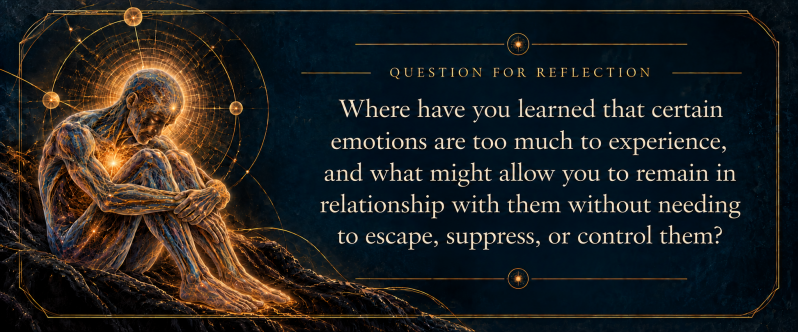
Where have you learned that certain emotions are too much to experience, and what might allow you to remain in relationship with them without needing to escape, suppress, or control them?
From Emotional Dysregulation to Grief and Loss
Emotional dysregulation demonstrates what can happen when emotional demands exceed the capacity currently available to sustain them. Yet some experiences present a different challenge: they require the system to adapt to something that cannot simply be regulated away or restored to what it was before. From an FSRT perspective, grief asks how a living system reorganizes when loss changes the conditions of the Living Field itself.
This distinction leads into the next clinical application of FSRT: Grief, Loss, and the Reorganization of the Living Field.
Author
Alan Romano, LCSW
Founder, Psycholytic Services
Creator of Functional Systems Regulation Theory