
The Living Field

In Functional Systems Regulation Theory, the Living Field describes the interconnected biological, psychological, relational, social, cultural, environmental, and meaning-making systems within which human experience takes shape.
Human experience does not occur in isolation.
Functional Systems Regulation Theory begins with a simple proposition: a human being cannot be fully understood apart from the systems in which that person lives.
We are biological organisms, but we are also relational beings. Our nervous systems develop within families, relationships, communities, cultures, environments, histories, and systems of meaning. These forces do not merely surround us. They participate in shaping what feels safe, what feels threatening, what becomes familiar, and what our systems learn they must do to survive.
FSRT refers to this larger ecology of human experience as the Living Field.
The Living Field includes the internal and external conditions within which regulation occurs: the body, nervous system, relationships, attachment patterns,
family structures, social roles, culture, environment, material conditions, spirituality, meaning, and the accumulated experiences through which a person has learned how to remain organized. From this perspective, distress cannot always be understood by asking only:
What is happening inside this person?
We must also ask:
What is this person responding to?
A behavior that appears dysfunctional when viewed in isolation may make considerably more sense when understood within the field that produced it. Hypervigilance may have developed where vigilance was necessary. Dissociation may have emerged when remaining fully present exceeded available capacity. Emotional withdrawal may have protected connection when authentic expression threatened belonging.
The pattern may eventually become costly. But its persistence does not necessarily mean the system is defective. It may mean the system learned well. This is why one of the foundational commitments of FSRT is to assume intelligence before dysfunction.
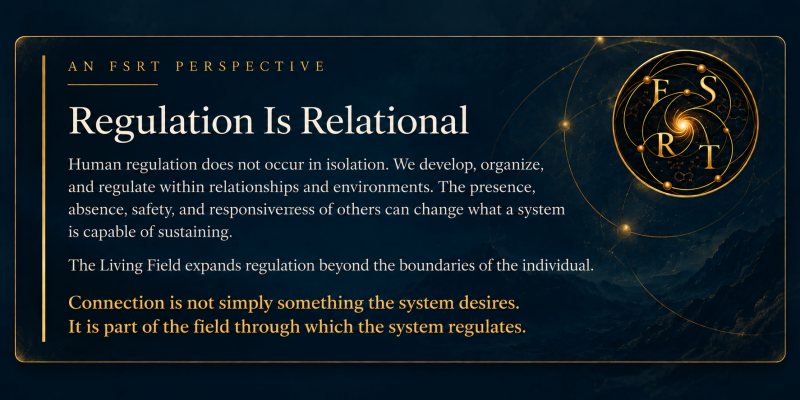
Regulation Is Not Contained Within the Individual
The people and environments around us do more than influence how we think or feel. They can alter what becomes possible for the system in a given moment. A person may have considerably more capacity to experience grief in the presence of someone who feels safe than when they are alone. Someone who becomes highly defended during conflict may find that the same difficult conversation becomes tolerable when the other person remains responsive rather than threatening or withdrawing. A nervous system that remains vigilant in one environment may gradually become less vigilant when the conditions that once required vigilance are no longer present.
This means that capacity is not always a fixed characteristic located entirely within the person. What someone can sustain may change depending on who is present, what the environment requires, whether belonging feels secure, and whether the person has access to relationships and structures that support regulation. The same individual can appear remarkably regulated in one part of their Living Field and significantly dysregulated in another.
This is also why connection cannot be understood only as a psychological preference or social need. Relationships can participate directly in regulation. They can increase or decrease uncertainty, reinforce protective patterns, create opportunities for repair, and provide conditions in which responses that were once necessary may gradually become less necessary. Over time, repeated experiences within a different relational field can contribute to what the system learns it is capable of sustaining.
The Living Field also helps explain why insight alone does not always produce lasting change. A person may understand a pattern intellectually and genuinely desire something different, while continuing to live within relational, physiological, environmental, or social conditions that reinforce the organization they are trying to leave behind.
The individual may be ready for change while the larger system remains organized around continuity. In FSRT, healing therefore cannot be reduced to symptom elimination or an altered internal state. It involves changes in capacity, relationship, environment, participation, and the conditions the system can sustainably inhabit. The goal is not to become independent of the Living Field. There is no life outside of it.
The work is to develop enough capacity, flexibility, awareness, and support that participation in the field no longer requires the same protective organization that once made survival possible. Healing does not occur in isolation because suffering did not emerge there either.
Continue Exploring FSRT
The Living Field is the beginning of a larger framework for understanding how human systems regulate, adapt, and change. Continue with Homeostatic Patterning to explore why systems often return to familiar ways of organizing, even when something different has become possible.
Author
Alan Romano, LCSW
Founder, Psycholytic Services
Creator of Functional Systems Regulation Theory