
Functional Systems Regulation Theory
A Systems-Oriented Framework for Understanding Human Suffering, Regulation, Adaptation, and Sustainable Change
Functional Systems Regulation Theory (FSRT) is a systems-oriented framework for understanding human experience as emerging through the continuous interaction of biological, psychological, relational, social, cultural, environmental, and meaning-making systems. Rather than locating distress solely within the individual, FSRT examines how patterns of regulation and adaptation develop within the larger conditions in which a person lives.
FSRT begins from the premise that many patterns commonly understood only as symptoms or dysfunction may also represent attempts by a living system to regulate, adapt, protect, or maintain stability under the conditions it has encountered. The central question therefore shifts from simply asking what is wrong to understanding what a pattern may be doing, how it developed, and what conditions are necessary for the system to reorganize into something more sustainable.
HUMAN SUFFERING DOES NOT OCCUR IN ISOLATION
From the Individual to the Living Field
To understand human suffering beyond the limits of the isolated individual, we have to widen the frame through which human experience is understood. What occurs within a person is continuously shaped by what occurs around them, between them and others, and across the larger systems in which their life unfolds.
FSRT describes this interconnected context as the Living Field. Within it, regulation emerges across multiple interacting domains, from the body and nervous system to relationships, communities, culture, ecology, and questions of meaning and existence.
The individual is not removed from the picture. The picture becomes larger.
Human regulation emerges across interacting domains of the Living Field.
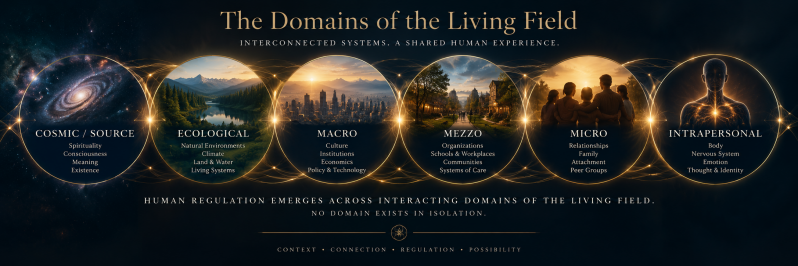
No domain exists in isolation.
| Levels | What they include |
|---|---|
| Intrapersonal | Body, nervous system, thought, emotion, memory, identity, meaning, and internal organization. |
| Micro | Close relationships, family, attachment, partnership, caregiving, and immediate interpersonal life. |
| Mezzo | Groups, workplaces, schools, neighborhoods, communities, and local institutions. |
| Macro | Culture, economics, healthcare, law, politics, technology, and social structures. |
| Ecological | Place, climate, land, built environments, nonhuman life, and the natural world. |
| Cosmic/Source | Spiritual, existential, ancestral, transpersonal, and larger meaning-making dimensions. |
A DIFFERENT STARTING POINT
What if the question isn't - "What's wrong with you?"
What if the better question is - What has your system learned to organize around?"
Functional Systems Regulation Theory begins with a different assumption.
Human distress does not necessarily indicate defect or dysfunction. Patterns of anxiety, depression, avoidance, addiction, hypervigilance, disconnection, or emotional dysregulation may become more understandable when we examine the conditions within which they developed.
Rather than beginning with pathology, FSRT begins with organization, adaptation, and context.
FROM ISOLATED PATHOLOGY → TO SYSTEMIC UNDERSTANDING

Before judging a pattern as dysfunctional, FSRT asks what intelligence may exist within the adaptation.
EXPLORE THE FRAMEWORK
Functional Systems Regulation Theory offers a language for understanding how human beings organize, adapt, suffer, heal, and participate within interconnected living systems.
These concepts form part of the framework through which FSRT approaches human experience.
Core Concepts of the Framework
The Living Field

The interconnected biological, relational, cultural, ecological, and larger systems through which experience emerges.
HOMEOSTATIC PATTERNING

The tendency of systems to return toward familiar forms of organization that they have learned to predict and sustain
THE DELUSION OF COMFORT

The mistaken experience of familiarity as safety, health, or genuine regulation; even when the familiar pattern perpetuates suffering.
SACRED DISTRESS

A threshold state in which existing organization is strained beyond its usual capacity, creating the possibility of rupture, reorganization, or both.
RELATIONSHIP & REGULATION

Human regulation is relational. We develop, adapt, regulate, and reorganize through participation with others. Relationship is not merely a setting in which healing occurs; it can become part of the regulatory process itself.
INTEGRATION AS REORGANIZATION

Change becomes meaningful when it can be lived. Insight and altered states are not synonymous with integration. Integration occurs as new capacities become increasingly sustainable within relationships, choices, responsibilities, meaning, and everyday life.
Healing Beyond the Limits of the Isolated: Functional Systems Regulation Theory — Volume I: Orientation
Healing Beyond the Limits of the Isolated introduces Functional Systems Regulation Theory as a framework for understanding human suffering beyond the boundaries of the isolated individual.
Rather than beginning with the assumption that distress represents defect, FSRT examines how human experience emerges through interacting biological, psychological, relational, cultural, ecological, and larger systems—and how patterns that appear dysfunctional may have developed as meaningful adaptations to the conditions in which a person has lived.
The book invites readers to reconsider not only how suffering is understood, but what becomes possible when healing is approached as reorganization, increased capacity, and renewed participation in life.
“Not all suffering is pathology. Sometimes suffering is initiation.” - Alan Romano

ADAPTATION • REGULATION • PARTICIPATION

About the Founder
The Person Behind the Framework
Alan Romano, LCSW
Psychotherapist · Author · Educator · Founder of Functional Systems Regulation Theory
Functional Systems Regulation Theory emerged from my effort to develop a more integrated language for understanding human suffering; one capable of holding biological regulation, psychological experience, relationship, culture, environment, meaning, and the larger systems within which human life unfolds.
Across my work as a psychotherapist, educator, writer, and practitioner, I have repeatedly returned to a central question:
What changes when we stop treating the individual as though they exist apart from the systems that shaped them?

FSRT developed through sustained clinical observation, interdisciplinary study, and an ongoing effort to understand patterns of suffering not simply as symptoms to eliminate, but as forms of organization that may carry histories of adaptation, protection, survival, relationship, and meaning.
The framework continues to evolve around a central commitment: to understand human experience within the living systems that make it possible, and to approach healing not simply as symptom reduction, but as the restoration of capacity for meaningful participation in life.

CONTINUE EXPLORING
ENTER THE FSRT FRAMEWORK
Functional Systems Regulation Theory™ begins with a different understanding of human suffering: no person exists in isolation, and no symptom can be fully understood apart from the system in which it developed.
Explore the foundational concepts, principles, and architecture through which FSRT understands regulation, relationship, adaptation, integration, and sustainable change.
Looking for Clinical Services?
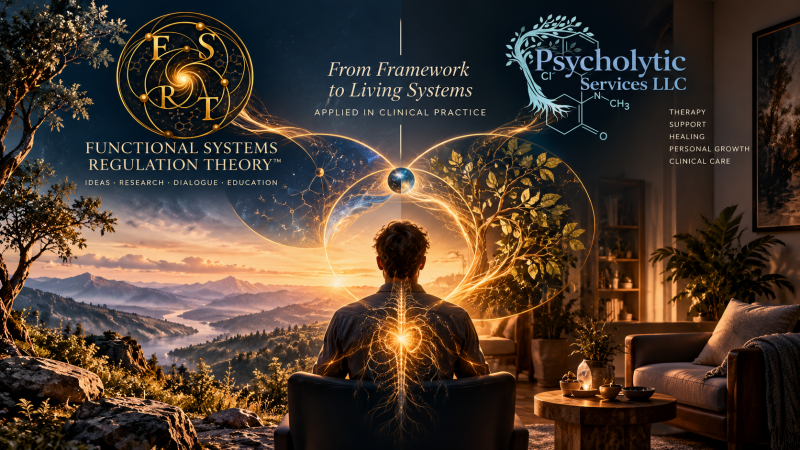
Functional Systems Regulation Theory™ is a theoretical and clinical framework. Psychotherapy and clinical services informed by FSRT are provided separately through Psycholytic Services LLC.
Psycholytic Services is the independent clinical practice of Alan Romano, LCSW, where psychotherapy and integrative clinical services may be informed by principles of Functional Systems Regulation Theory.
Author
Alan Romano, LCSW
Founder, Psycholytic Services
Creator of Functional Systems Regulation Theory