
A Nation Losing Its Attention
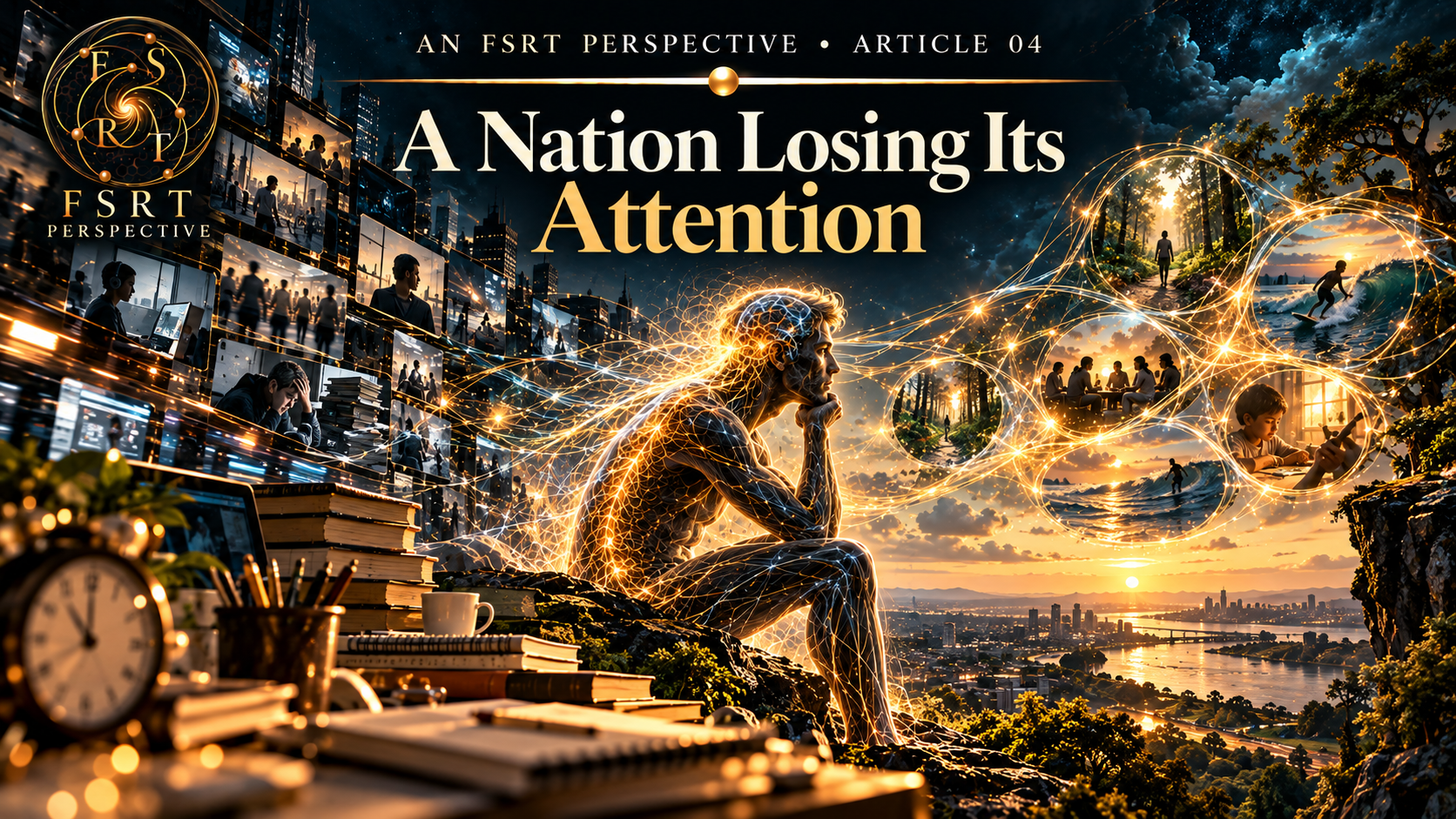
Psycholytic Perspectives examines contemporary psychological and cultural questions through the developing lens of Functional Systems Regulation Theory. This companion reflection places A Nation Losing Its Attention within the larger architecture of FSRT, exploring what attention may reveal when we look beyond symptoms and examine how the system organizes itself in response to the demands, stimulation, relationships, and environments in which attention emerges.
Through an FSRT Lens
Attention is often treated as though it originates primarily inside the individual. FSRT widens that frame. Rather than beginning with the assumption that difficulty sustaining attention represents a malfunction within the person, it asks what the system may be responding to, what conditions are competing for its attention, and what function the current organization may be serving.
Attention is not simply the ability to focus. It is an expression of what a living system has learned to notice, prioritize, anticipate, avoid, and respond to. Difficulty with attention may emerge through many pathways, including chronic stress, overstimulation, relational insecurity, trauma, sleep disruption, biological vulnerability, digital saturation, environmental mismatch, competing demands, or the cumulative burden of navigating conditions that continually fragment awareness.
From an FSRT perspective, a person struggling with attention is therefore not simply a brain failing to concentrate. They are a living system embedded within relationships, history, biology, environment, culture, technology, expectations, meaning, and daily demands. What we call inattention, distractibility, impulsivity, or hyperactivity may reflect the interaction of many of these conditions rather than a single underlying cause.
This changes the starting question. Instead of asking only “What is wrong with this person’s attention, and how do we make them focus?” FSRT also asks: “What is this system attending to, what has it learned it must remain responsive to, and what conditions would allow attention to organize differently?”
Attention Within the Living Field
Two people can meet the same diagnostic criteria for ADHD while arriving there through entirely different pathways. One may be navigating neurodevelopmental differences, another chronic stress, trauma, sleep disruption, overstimulation, relational instability, environmental mismatch, or some interaction among many of these factors. The diagnosis may be the same. Their Living Fields are not.
FSRT understands the Living Field as the interconnected conditions within which a person lives and regulates: relationships, biology, history, environment, culture, technology, resources, demands, meaning, and the systems in which they participate. These are not simply background influences surrounding attention. They continually interact with the person and with one another, shaping what the system must notice, filter, prioritize, ignore, and respond to.
This means similar attentional difficulties do not necessarily reveal the same underlying organization. Distractibility may emerge from overstimulation in one person, hypervigilance in another, exhaustion in someone else, or from a nervous system that has learned to remain highly responsive to novelty, movement, threat, or changing demands. Even when the outward expression looks similar, the Regulatory Burden carried by each system may be profoundly different.
From an FSRT perspective, that difference matters. Variation in how people experience attention and respond to treatment is not simply noise. It may be information about what the system has learned to attend to, what is competing for its available capacity, what is sustaining its current organization, and what conditions would need to change for attention to organize differently.

Assume Intelligence Before Dysfunction
One of the foundational commitments of FSRT is to assume intelligence before dysfunction. This does not mean denying impairment, minimizing suffering, or suggesting that every pattern is inherently beneficial. It means resisting the impulse to interpret a pattern as meaningless simply because it creates difficulty.
Inattention, movement, impulsivity, novelty seeking, stimulation seeking, and rapid shifts in attention can all create substantial challenges in school, work, relationships, and daily life. But the presence of impairment does not tell us why the pattern exists, what conditions intensify it, or what the system may be attempting to accomplish through it.
A person who continually scans their environment may appear distracted while their system is prioritizing information beyond the task immediately in front of them. Someone who seeks movement or stimulation may be discovering, consciously or not, conditions under which attention becomes easier to organize. Rapid shifts in attention may interfere with sustained tasks while simultaneously supporting responsiveness to novelty, changing environments, or multiple streams of information.
FSRT does not require us to romanticize these patterns. It asks us to become curious about them.
Before concluding that a system is failing, we ask what the pattern may be accomplishing, what conditions may have shaped it, and whether something that appears dysfunctional in one environment may represent an intelligent adaptation to another.
When Regulation Becomes Regulatory Burden
The visible difficulty with attention may represent only a small portion of what the system is actually managing. A person may be expending substantial regulatory capacity trying to remain seated, suppress movement, resist competing stimuli, organize tasks, remember instructions, track time, inhibit impulses, recover after distraction, regulate frustration, anticipate expectations, and repeatedly redirect attention toward activities that do not naturally sustain it.
From the outside, we may see difficulty focusing. From inside the system, an enormous amount of work may already be occurring.
FSRT describes Regulatory Burden as the cumulative demand placed upon a system as it attempts to maintain functioning, stability, adaptation, and participation. When significant capacity is continually devoted to managing attention and meeting environmental expectations, less capacity may remain available for learning, creativity, relationships, emotional regulation, rest, and meaningful participation.
This distinction matters because increased effort does not necessarily produce increased capacity. A person may become highly skilled at forcing themselves through an environment while simultaneously becoming exhausted by the effort required to do so.
The question is therefore not only whether someone can maintain attention, but how much of the system must be recruited to make that attention possible.
From Managing Attention to Reorganizing Capacity
Treatment can be enormously helpful. Medication may improve attentional stability, impulse control, or task initiation. Environmental accommodations may reduce unnecessary demands. Structure can decrease the amount of information the system must continually organize. Movement may support regulation. Psychotherapy can help identify patterns, develop skills, and address emotional or relational burdens. Sleep, nutrition, exercise, meaningful activity, and supportive relationships can further influence the capacity available to the system.
FSRT does not position these approaches against one another. It asks a different question about what treatment is ultimately attempting to accomplish.
If an intervention changes observable behavior but requires the person to continually override their own regulatory needs, meaningful burden may remain. Conversely, when treatment reduces unnecessary demands, increases available capacity, strengthens regulation, and allows the person to participate more fully in their life, something deeper than symptom management may be occurring.
This is where Integration as Reorganization becomes important. Sustainable change is not simply the ability to perform differently for a period of time. It involves the development of conditions under which a different pattern becomes increasingly possible to maintain. The goal therefore becomes larger than producing better attention.
The FSRT question is whether intervention merely changes what others can observe, or whether it expands what the person can sustainably regulate, engage with, and participate in across the Living Field
Read the Full Essay
This FSRT Perspective expands upon ideas explored in:
Psycholytic Perspectives by Alan Romano, LCSW
The full essay explores how contemporary understandings of ADHD and attention developed, from early observations of stimulant treatment to the expanding demands placed upon attention in modern life. It considers medication, environment, technology, education, movement, culture, and individual variation while asking whether some of what we identify as attentional dysfunction may also reveal something about the conditions under which human attention is being asked to operate.

Author
Alan Romano, LCSW
Founder, Psycholytic Services
Creator of Functional Systems Regulation Theory