
A Nation Afraid to Feel: Anxiety and the Illusion of Safety

Psycholytic Perspectives examines contemporary psychological and cultural questions through the developing lens of Functional Systems Regulation Theory. This companion reflection places A Nation Afraid to Feel within the larger architecture of FSRT, exploring anxiety not simply as a symptom to eliminate, but as a regulatory response emerging within the conditions a person has learned to navigate.
Through an FSRT Lens
Anxiety is commonly approached as something to reduce, control, or eliminate. Functional Systems Regulation Theory begins somewhere different. Before asking how to make anxiety disappear, FSRT asks what the anxiety may be attempting to accomplish.
Anxiety prepares a system for what it has learned might happen. It increases attention, anticipates threat, mobilizes the body, narrows uncertainty, and encourages behaviors that may reduce exposure to what feels dangerous. Even when the response appears disproportionate to the present moment, the regulatory logic beneath it may have developed within conditions where vigilance, preparation, avoidance, or control once served an important function.
From this perspective, the question shifts from “How do we stop the anxiety?” toward “What has this system learned it must anticipate, prevent, or control in order to remain safe?”
Safety Is More Than the Absence of Danger
FSRT understands safety as more than the absence of immediate threat. A person may no longer be in danger while still living within a system that has not reorganized around safety. The body may remain vigilant, relationships unpredictable, financial pressures unresolved, or social and family environments demanding.
This is where the Living Field becomes important. Human beings regulate within relationships, environments, resources, expectations, histories, and institutions. Safety is therefore not simply something a person decides to feel. It is something the system learns through repeated experience.
A person may cognitively know they are safe while their regulatory system continues to anticipate disruption. This does not necessarily mean the system is misreading reality. It may be responding according to what experience has taught it to expect.
The absence of immediate danger does not necessarily create the presence of safety.
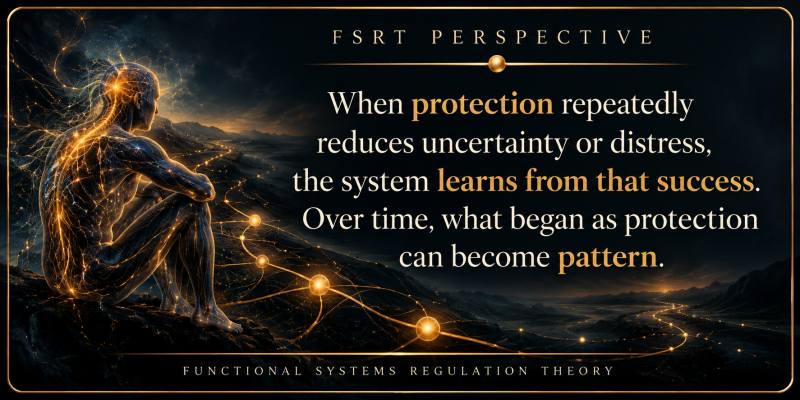
When Protection Becomes Pattern
Anxiety does not only produce a feeling. It can organize behavior around preventing, reducing, or escaping what the system has learned to experience as threatening. Avoidance, reassurance seeking, checking, overpreparation, rumination, withdrawal, and attempts to control uncertainty can all serve this protective function.
When these strategies reduce activation, even temporarily, the system learns from the result. Avoiding the situation prevents the feared experience. Checking provides a moment of certainty. Reassurance quiets doubt. Control makes uncertainty feel more manageable. In the immediate moment, the strategy works.
FSRT understands this through Homeostatic Patterning. Systems tend to return toward familiar forms of regulation that have previously helped them maintain stability. The pattern may eventually restrict a person's life, but restriction does not mean the pattern is without function. What looks like dysfunction from the outside may still be performing an important regulatory role from within the system.
This creates one of anxiety's central paradoxes: the strategies that create immediate safety can also prevent the experiences through which greater capacity might develop. The person becomes increasingly organized around avoiding what the system has not yet learned it can sustain.
The goal, then, is not simply to take protection away. It is to understand what the protection is accomplishing and create conditions in which the system no longer needs to rely upon it in the same way.
The Illusion of Safety
Anxiety often creates a powerful bargain: if I can reduce enough uncertainty, I will finally feel safe. The person may avoid what feels threatening, seek reassurance, prepare for every possibility, monitor the body, control the environment, or attempt to anticipate what might happen next. Each strategy can provide temporary relief.
But certainty and safety are not the same thing.
From an FSRT perspective, the illusion of safety emerges when the system becomes organized around the belief that sufficient control can eliminate uncertainty. The more safety depends upon preventing particular feelings, situations, or outcomes, the more of life must be controlled for that safety to remain intact.
This can gradually narrow the system's world. Avoidance reduces opportunities for unexpected experiences. Reassurance makes uncertainty harder to tolerate without reassurance. Control can make the uncontrollable feel increasingly threatening. The strategies designed to create safety can therefore reinforce the conditions that make safety feel fragile.
FSRT does not ask the system to abandon protection before it has something more sustainable available. The deeper work is to increase the system's capacity to encounter uncertainty without requiring certainty in order to remain organized.
Safety is not the guarantee that nothing difficult will happen. It is the growing capacity to remain organized when we cannot know what happens next.
Capacity Changes the Relationship to Anxiety
FSRT does not define progress by how little anxiety a person feels. The more important question is whether the system has developed greater capacity to remain present when anxiety, uncertainty, or activation arises.
This reflects a central FSRT principle: capacity precedes intensity. A system does not reorganize simply because it is exposed to more discomfort. If an experience exceeds what the system can sustain, familiar protective patterns may become even more necessary. Change becomes possible when challenge occurs within enough safety, support, and capacity that the system can encounter something difficult without becoming overwhelmed.
As capacity expands, the relationship to anxiety can begin to change. Uncertainty can be experienced without immediately requiring control. Activation can arise without automatically triggering avoidance. Difficult sensations can be felt without being interpreted as evidence that something must be escaped or eliminated.
The anxiety itself may still appear. What changes is how much organization it requires around it.
Over time, these experiences provide the system with new information: I can feel this and remain here. I can be uncertain and continue. I do not have to eliminate this experience in order to sustain myself.
From an FSRT perspective, this is where reorganization begins. The goal is not fearlessness. It is a system with enough capacity that fear no longer has to determine the boundaries of a person's life.
Healing Is Not the Elimination of Anxiety
Anxiety is part of the human regulatory system. It alerts, anticipates, prepares, and protects. From an FSRT perspective, healing does not require eliminating that capacity. It requires changing the degree to which anxiety must organize the system around protection.
A person may still experience fear before something uncertain, activation during conflict, or anxiety when circumstances become unstable. The difference is that these experiences no longer automatically require avoidance, control, reassurance, or withdrawal in order for the system to remain intact.This is why symptom reduction alone cannot fully describe reorganization. A quieter system is not necessarily a more capable one. Lasting change becomes visible in what the person can increasingly experience, tolerate, and participate in without returning to the same protective organization. The aim is therefore not a life without anxiety. It is greater freedom within its presence.
Healing does not require a system to stop detecting uncertainty. It requires enough capacity that uncertainty no longer determines how the system must organize.
Read the Full Essay
This FSRT Perspective expands upon ideas explored in:
A Nation Afraid to Feel: Anxiety and the Illusion of Safety
Psycholytic Perspectives by Alan Romano, LCSW
The full essay examines anxiety within a broader cultural pursuit of safety, certainty, and control, and considers what may be lost when discomfort itself becomes something we are increasingly unwilling to experience.

Author
Alan Romano, LCSW
Founder, Psycholytic Services
Creator of Functional Systems Regulation Theory