
A Nation Regulating Its Pain: Opioids and the American Delusion of Comfort
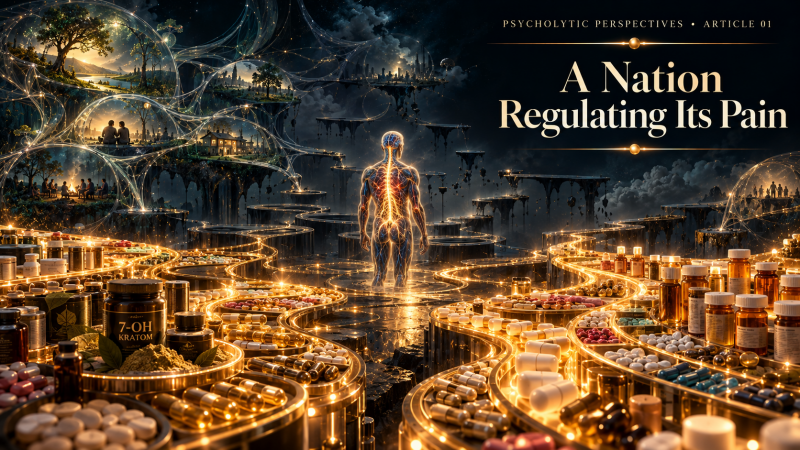
Psycholytic Perspectives examines contemporary psychological and cultural questions through the developing lens of Functional Systems Regulation Theory. This companion reflection places A Nation Regulating Its Pain within the larger architecture of FSRT, exploring what the opioid crisis may reveal about suffering, regulation, and the conditions in which people are asked to function.
Through an FSRT Lens
The opioid crisis cannot be understood only through the substances themselves. It emerged within a culture that increasingly treated pain as something to be eliminated, a medical system that moved from widespread and at times excessive prescribing toward increasingly restrictive and, in some cases, inadequate prescribing, and a society that often left the conditions producing physical and psychological suffering largely unchanged. Functional Systems Regulation Theory asks us to examine the entire regulatory system in which opioid use emerged, escalated, and continues to evolve.
From an FSRT perspective, opioids are neither inherently the problem nor an adequate explanation for the crisis. They are powerful regulatory tools. They can relieve severe physical pain, quiet overwhelming distress, create temporary distance from suffering, and allow a person to continue functioning when the demands placed upon them exceed what their system can presently sustain. The more important question is not simply why opioids became so widely used, but what they were being asked to regulate.
That question becomes even more important when access to opioids is reduced or removed. If the underlying pain, trauma, isolation, economic pressure, relational instability, medical conditions, or other sources of regulatory burden remain, removing the substance does not necessarily remove the need it was serving. The system is still required to regulate. It may seek another pathway, endure greater distress, or lose a form of stability it had come to depend upon.
This is where FSRT locates the Delusion of Comfort. The problem is not comfort itself. Relief matters. Pain treatment matters. The delusion begins when the reduction of discomfort is mistaken for the resolution of the conditions producing it, or when the removal of a source of relief is mistaken for healing. Neither prescribing nor restricting a substance, by itself, reorganizes the system that made that form of regulation necessary.
Pain Does Not Exist in Isolation
FSRT begins from the premise that human beings do not regulate in isolation. Pain occurs within a Living Field composed of the body, relationships, family systems, community, work, economic conditions, culture, institutions, history, environment, and the meanings through which a person understands their experience. These elements do not simply surround the individual. They participate in the conditions under which regulation becomes possible or increasingly difficult.
When that field provides sufficient connection, safety, meaning, resources, and support, regulatory burden can be distributed across the system. When those structures weaken or disappear, more of that burden falls onto the individual. A person may still be expected to work, parent, maintain relationships, manage illness, absorb loss, navigate financial pressure, and continue functioning while having progressively fewer places for distress to go.
Opioids can enter this field as an extraordinarily effective form of regulation. They may reduce physical pain, but their effects can extend beyond pain alone. For some people, they can temporarily soften fear, emotional distress, loneliness, exhaustion, or the felt intensity of circumstances that otherwise seem impossible to carry. What appears from the outside as a relationship with a substance may therefore also reflect a relationship between the person and a larger field that has become increasingly difficult to inhabit.
This changes the question. Rather than asking only what is wrong with the person or the substance, FSRT asks: What has this form of regulation made possible for the system, and what would need to change for the system to no longer depend upon it in the same way?
When Relief Becomes Regulation
Relief is not inherently pathological. When a person is in pain, the movement toward relief is an intelligent regulatory response. Opioids are particularly powerful because they can rapidly alter the experience of physical pain while also changing the felt intensity of distress. For a system carrying more than it can presently sustain, that shift can be profoundly regulating.
Repeated relief, however, can become more than an interruption of suffering. When a particular intervention reliably reduces distress, restores function, or makes an otherwise intolerable state manageable, the system begins to recognize it as a dependable regulatory pathway.
From an FSRT perspective, this matters because regulation is not simply a conscious decision. Human systems continuously learn from what successfully moves them away from states they cannot sustain. If opioids repeatedly allow someone to sleep, work, tolerate physical pain, soften emotional overwhelm, remain socially engaged, or simply make it through the day, the system learns something important: this works.
The regulatory function can therefore become larger than the original reason the substance was introduced. What may have begun as relief from physical pain can become woven into how the person manages distress, energy, emotion, connection, expectation, and everyday functioning. This is not evidence that the system has stopped trying to heal.
From an FSRT perspective, it may be evidence that the system has found a reliable way to remain within conditions it does not yet have another way to sustain.

When Regulation Becomes Organization
What regulates us repeatedly can eventually become part of how we organize. FSRT describes this through Homeostatic Patterning: the tendency of living systems to return toward familiar configurations that have previously allowed them to maintain continuity, even when those configurations carry significant costs.
Once opioids have become integrated into a person's regulatory architecture, their role can no longer be understood only in terms of the substance itself. The body has adapted. Expectations have adapted. Daily routines may have adapted. Relationships may have adapted. The person's sense of what is tolerable, manageable, or necessary to function may have adapted. The surrounding Living Field may also have organized around the person's ability to continue functioning while that regulatory support is present.
Removing the opioid therefore does not simply remove relief. It can disrupt an organization that has developed around its presence.
A regulatory strategy can be taken away much faster than the system can develop the capacity, relationships, resources, and alternative patterns necessary to function without it. When that happens, the original regulatory burden does not disappear. In some cases, it increases.
The return to a familiar regulatory strategy can then appear from the outside as failure, resistance, or an unwillingness to change. FSRT offers another possibility: the system may be returning to what it can currently sustain.
Lasting change therefore requires more than interrupting a pattern. It requires creating conditions in which a different organization becomes possible.
Reorganization Requires More Than Removal
If a system has organized around a particular form of regulation, removing that form of regulation does not itself create a healthier organization. It creates an absence. What happens next depends upon what the system has available to take its place. This distinction is particularly important in the history of opioids. As the consequences of widespread prescribing became increasingly visible, the cultural and medical response shifted toward restriction. In many cases, reducing unnecessary exposure was appropriate. But from an FSRT perspective, restriction alone could never resolve the larger problem. A prescription can be reduced much faster than a human system can reorganize.
If physical pain remains untreated, trauma remains unresolved, relationships remain unstable, economic pressures remain unchanged, or meaningful sources of connection and support remain absent, the regulatory burden is still present. The system has simply lost one of the mechanisms through which it had learned to carry it. This is why FSRT distinguishes removal from reorganization. Lasting change requires more than eliminating a behavior, substance, symptom, or coping strategy. It requires developing sufficient capacity and changing enough of the surrounding conditions that the previous regulatory strategy is no longer required to perform the same function.
The goal, then, is not simply to make the opioid disappear. Nor is it to preserve opioid use indiscriminately. It is to understand what the opioid has been doing within the larger system and to ask what would need to become possible for that system to organize differently.
Healing is not demonstrated by what a system can be forced to relinquish. It is revealed by what the system becomes capable of sustaining without it.
Read the Full Essay
This FSRT Perspective expands upon ideas explored in:
A Nation Regulating Its Pain: Opioids And The American Delusion of Comfort
Psycholytic Perspectives by Alan Romano, LCSW
The full essay examines the opioid crisis within the broader cultural relationship to pain, relief, medicine, and human suffering.

Author
Alan Romano, LCSW
Founder, Psycholytic Services
Creator of Functional Systems Regulation Theory