
A Nation Medicating Its Depression
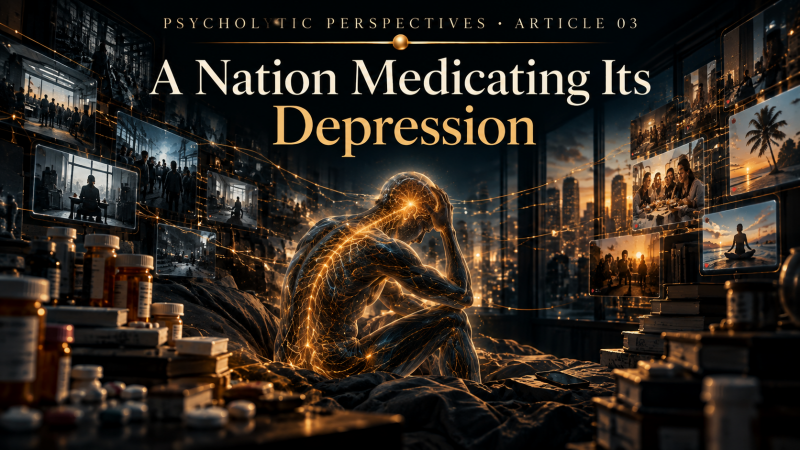
Psycholytic Perspectives examines contemporary psychological and cultural questions through the developing lens of Functional Systems Regulation Theory. This companion reflection places A Nation Medicating Its Depression within the larger architecture of FSRT, exploring what depression may reveal when we look beyond symptoms and examine the system in which suffering emerges.
Through an FSRT Lens
Depression is often treated as though it originates primarily inside the individual. FSRT widens that frame. Rather than beginning with the assumption that depression represents a malfunction within the person, it asks what the system may be responding to, what conditions have shaped that response, and what function the current organization may be serving.
Depression is not sadness. It is what can emerge when sadness has nowhere to be held, nowhere to move, and no space to become something else. But sadness is only one possible pathway. Depression may also emerge through prolonged grief, chronic stress, relational disconnection, trauma, exhaustion, biological vulnerability, loss of meaning, or the cumulative burden of adapting to conditions that exceed what a system can sustainably carry.
From an FSRT perspective, a depressed person is therefore not simply a brain producing symptoms. They are a living system embedded within relationships, history, biology, environment, culture, work, loss, meaning, and daily demands. What we call depression may reflect the interaction of many of these conditions rather than a single underlying cause.
This changes the starting question. Instead of asking only “What is wrong, and how do we reduce it?” FSRT also asks: “What has this system been carrying, what has it had to organize around, and what might need to change for another way of living to become sustainable?”
Depression Within the Living Field
Two people can meet the same diagnostic criteria for depression while arriving there through entirely different pathways. One may be carrying grief, another chronic stress, trauma, isolation, illness, relational loss, economic insecurity, biological vulnerability, or some interaction among many of these factors. The diagnosis may be the same. Their Living Fields are not.
FSRT understands the Living Field as the interconnected conditions within which a person lives and regulates: relationships, biology, history, environment, culture, resources, demands, meaning, and the systems in which they participate. These are not simply background influences surrounding depression. They continually interact with the person and with one another, shaping what the system must carry and how it adapts.
This means similar symptoms do not necessarily reveal the same underlying organization. Withdrawal may emerge from grief in one person, exhaustion in another, and prolonged relational threat or disconnection in someone else. Even when the outward expression looks similar, the Regulatory Burden carried by each system may be profoundly different.
From an FSRT perspective, that difference matters. Variation in how people experience depression and respond to treatment is not simply noise. It may be information about what the system is responding to, what is sustaining its current organization, and what conditions would need to change for something different to become possible.
When Symptom Reduction Is Not Reorganization
FSRT does not dismiss symptom relief. Relief can restore functioning, reduce suffering, and create the stability necessary for deeper change to become possible. In some circumstances, reducing symptoms may be precisely what a system needs before it has the capacity to engage anything further. The distinction is not between symptom relief and “real” healing. It is between reducing distress and assuming that the conditions organizing that distress have therefore changed.
If sadness becomes quieter while isolation, grief, exhaustion, relational strain, loss of meaning, or chronic stress remain unchanged, the system may feel different without yet being organized differently. Medication, psychotherapy, changes in environment, supportive relationships, or other interventions may reduce the immediate regulatory burden, but whether that relief develops into more durable change depends on what becomes possible afterward.
From an FSRT perspective, reorganization occurs when the system develops new capacities and more sustainable ways of regulating, relating, and participating. The person may become better able to experience emotion without becoming overwhelmed, engage relationships differently, tolerate uncertainty, establish boundaries, reconnect with meaning, or participate in parts of life that previously exceeded their capacity.
This is why FSRT distinguishes a change in state from a change in organization. Feeling better matters. Functioning better matters. Relief matters. But lasting change becomes visible in what the system can increasingly sustain over time.
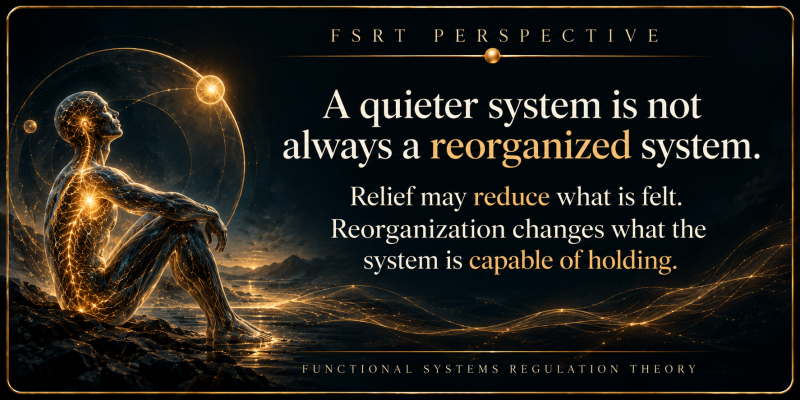
A quieter system is not always a reorganized system. Relief may reduce what is felt. Reorganization changes what the system is capable of holding.
Treat the System, Not Just the Symptom
FSRT asks more than what will reduce depression. It asks what the system is responding to, what is sustaining its current organization, what capacities may have become constrained, and what conditions would allow something more sustainable to emerge.
That may involve medication. It may also involve psychotherapy, sleep, physical health, grief, relationship, community, safety, purpose, environmental change, or some combination of these. Different interventions may serve different functions at different times. Medication may create enough stability for therapy to become possible. Therapy may help a person recognize patterns that once remained outside awareness. Changes in relationships, environment, or daily life may reduce burdens that no amount of individual insight could resolve on its own.
The task is not to decide in advance which level of intervention is correct. It is to understand how each intervention participates within the life of this particular person and whether, together, they are helping the system develop greater capacity for living.
This is where FSRT moves beyond the question of whether depression has improved. A person may experience fewer symptoms and still return to the same relationships, demands, isolation, patterns, or conditions that helped organize their distress. Lasting change requires more than asking the individual to function better within an unchanged system. Sometimes the person develops new capacities. Sometimes relationships must reorganize. Sometimes the surrounding environment must change. Often, change occurs across several of these levels at once.
The aim is not to construct a life in which sadness, grief, exhaustion, or distress never return. These experiences remain part of being human. The deeper question is whether the system has developed enough capacity, support, flexibility, and connection that these experiences no longer require the same organization around them.
Healing is not simply the disappearance of depression. It is the emergence of a life in which the system has more ways to respond, more capacity to remain present, and more freedom to participate in what matters.
Read the Full Essay
This FSRT Perspective expands upon ideas explored in:
A Nation Medicating Its Depression: Antidepressants, Placebo, and What We May Be Missing About Human Distress
Psycholytic Perspectives by Alan Romano, LCSW
The full essay examines antidepressant use, placebo, emotional blunting, withdrawal, and the systems through which depression is treated, while asking what may be missed when human distress is understood primarily through symptom reduction rather than the larger conditions in which it emerges.

Author
Alan Romano, LCSW
Founder, Psycholytic Services
Creator of Functional Systems Regulation Theory